fruit tree · Bétulacées
HazelnutCorylus avellana
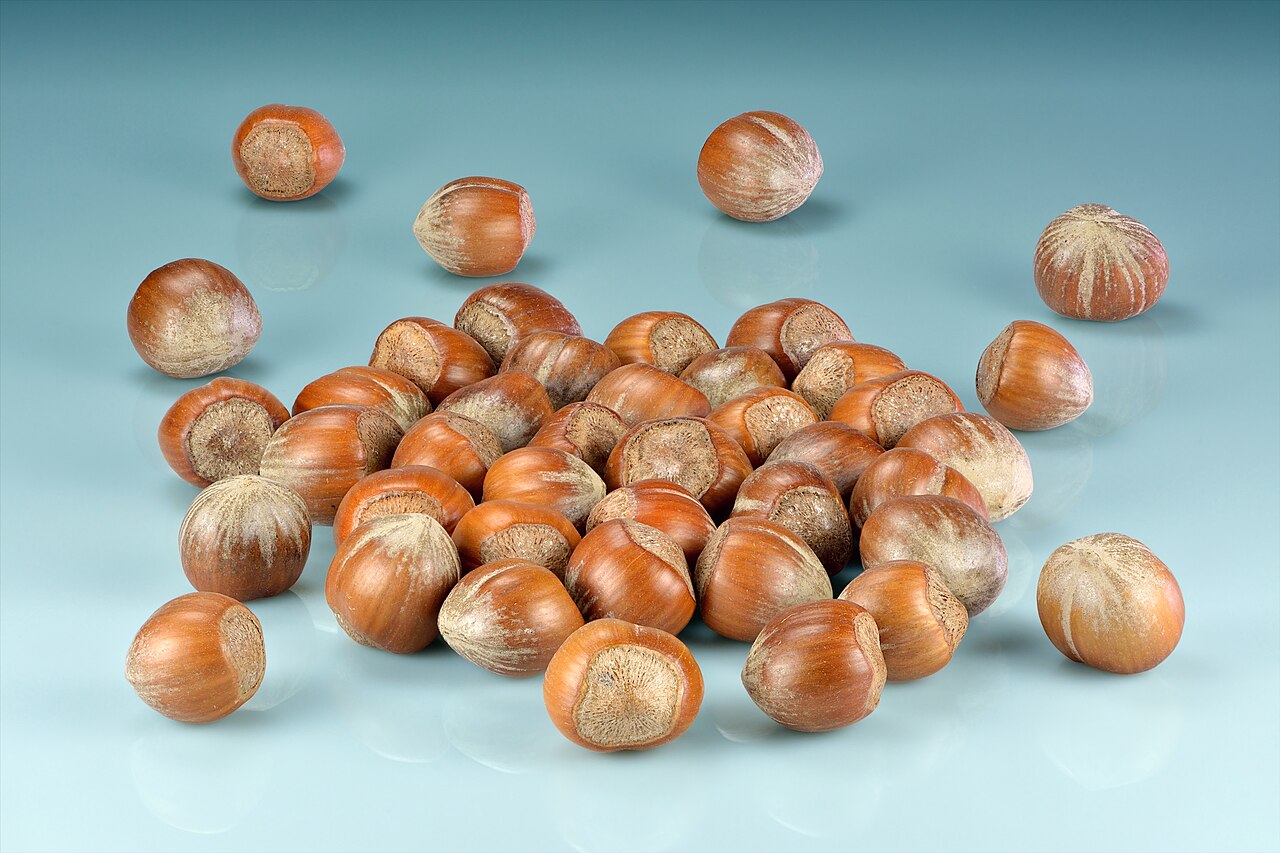
The hazel is the easiest shrub in the orchard: hardy, with no serious disease, it grows anywhere and fills the basket every autumn with nuts that keep all winter. Two complementary varieties, a corner of hedge, and the fresh September hazelnuts become a late-summer ritual.
- Difficulty
- Easy
- Exhibition
- Sun or partial shade
- Watering
- Moderate; young plants only in summer
- Floor
- Any soil, moist, drained, chalk included
- Spacing
- 4 to 5 m, or 2.5 m in a fruiting hedge
- Harvest
- 3 to 4 years after planting, full production after 8 years
Calendar · Belgian climate
When to sow, plant and harvest
| Activity | Jan | Feb | Mar | Apr | May | Jun | Jul | Aug | Sep | Oct | Nov | Dec |
|---|---|---|---|---|---|---|---|---|---|---|---|---|
| Plantation | yes | yes | yes | yes | yes | |||||||
| Harvest | yes | yes |
Step by step
1Choosing
The hazel is not self-fertile and flowers in the depths of winter: plant at least two compatible varieties, flowering at the same time, so that the wind-borne pollen can do its work. Merveille de Bollwiller, hardy and late, goes well with Fertile de Coutard or Segorbe; Lambert rouge, with its purple foliage, pollinates many varieties. Prefer large nuts with a thin shell. Buy two-year-old plants, as a stool or on a stem.
2Planting
Plant from November to March, outside frosty spells, in ordinary soil, chalk included, preferably moist. The hazel accepts partial shade, but fruits better in the sun. Space at 4 to 5 m, or 2.5 m in a fruiting hedge. Dig a wide hole, mix in compost, plant without burying the crown, water and mulch. Cut the stems back by a third to encourage branching. A young plant copes badly with competition from grass.
3Caring
Looking after it comes down to a light prune each winter: remove at ground level a third of the old stems over six years old to keep a bush of eight to ten stems, take out surplus suckers and crossing wood. The hazel fruits on the previous year's wood: do not shorten the young shoots. Water for the first two summers, mulch, and give a little compost in spring. No treatment is needed.
4Harvesting
The nuts fall by themselves when ripe, from late August to October: the husks brown and the nut comes away. Gather from the ground every two days, ahead of the squirrels, the jays and the field mice, or shake the branches over a sheet. Picked green from the tree, they are delicious fresh but do not keep. A mature bush gives 3 to 6 kg.
5Storing
Spread the nuts in a thin layer in a dry, airy, warm place for two or three weeks, stirring them, until the kernel is dry and crisp. They then keep for a year in their shells in a net or a basket in the dry. Shelled, keep them in the fridge or the freezer to avoid them going rancid. Dry-roasted, they give chocolate spread, praline and oil.
Further reading
Planting and caring for plants properly
How to plant properly
Choosing the varieties and pairing them
The hazel flowers from January to March, yellow male catkins and tiny red female flowers on the same shrub, but rarely at the same moment on the same plant: it is self-sterile and pollinated by the wind. Plant two or three varieties whose catkins release their pollen when the female flowers of the others are receptive. Merveille de Bollwiller, late, hardy, with big round nuts, pairs with Fertile de Coutard, Segorbe or Butler; Lambert rouge, with purple leaves, pollinates early and abundantly. Corabel and Ennis give the largest nuts. Place the pollinators downwind of the prevailing westerly, less than 15 m away.
Choosing the form: stool or standard
The hazel is planted on its own roots or from a layer, never grafted except as a standard on Corylus colurna, the Turkish hazel, which does not sucker and makes a small 5 m tree easy to mow under. As a stool, its natural form, it makes a bush of 8 to 10 stems 4 m tall, renewed from the base: this is the most productive and the hardiest. As a standard, it fits into a small garden, lets the mower past and is picked standing up, but lives less long. In a fruiting hedge, mix hazels, dogwoods and elders every 2.5 m for a productive windbreak screen. Buy a two-year-old bare-rooted plant, with at least three stems.
Choosing the spot
A native of our hedgerows, the hazel grows anywhere, but fruits distinctly better in the sun, in moist, deep soil, chalky or clay included. It tolerates the partial shade of a woodland edge and serves as a windbreak, which makes it the ideal companion on the west side of an orchard; it dislikes, on the other hand, dry, sandy soils, where the nuts stay empty, and waterlogged ground. Its winter flowering fears nothing but hard frosts below -12 °C. Space at 4 to 5 m for isolated stools, 2.5 m in a hedge, 3 m between standards. Keep 3 m from a fence: the roots sucker and the crown widens.
Preparing the hole and the soil
Dig a hole 60 cm square and 50 cm deep, breaking up the bottom. Mix into the soil two spadefuls of mature compost and a handful of hoof and horn; on acid soil, add a handful of magnesian lime, as the hazel prefers a pH of 6 to 7.5. On sandy soil, be generous with compost and leaf mould to hold the water. Weed out grass and couch grass carefully over a square metre: the young hazel suffers more from competition from grass than from anything else. A stake is needed only for the standard form, or in a very windy position.
Planting bare-rooted
From November to March, outside frosty spells, plant bare-rooted: trim the roots, dip them in a puddling mix, set the crown level with the soil for a standard, or 3 cm below for a stool that must send up shoots from the base. Fill in, firm, water with 15 litres, mulch over a metre in diameter with 10 cm of wood chippings. Cut the stems back by a third above an outward-facing bud to force branching; on a stool, remove the spindly stems to keep only four to six vigorous ones. A containerised plant can go in until May, with steady watering all summer. No fertiliser in the first year.
In a pot or container
A hazel in a container remains a curiosity: it needs two varieties, so two 80-litre containers, and its production rarely exceeds a handful of nuts. If you try it on a large terrace, choose compact varieties, Merveille de Bollwiller and Lambert rouge, a mix of garden soil and compost, watering every two days in summer and a hard cutting back each winter to keep it under 2 m. The corkscrew hazel, an ornamental, does better there and sometimes gives a few nuts. The container is worth it above all for a terrace windbreak hedge, rather than for the harvest.
Beginner's mistakes
The first is planting a single hazel, or two plants of the same variety, and getting nothing but empty shells: the husks form without a kernel for want of pollination. The second is leaving it in long grass without a mulch: it sits there for three years. Many also shorten all the young shoots in winter, removing the catkins and the flowers they carry. You still see hazels planted 1 m from a fence or a path that they invade with suckers. Finally, waiting for the nuts to fall of their own accord before gathering them is feeding the squirrels and the jays before yourself.
Look after it properly
Watering in the first years
For the first two summers, water every week in dry weather, 15 litres at the base, from May to August: the hazel roots near the surface and suffers from drought as long as it is not established. The filling of the kernels is decided in July and August; a shortage of water at that moment gives small, shrivelled or empty nuts, even on a mature shrub. After that, only a very dry summer justifies a generous watering every fortnight in July. A mature hazel in moist loam is entirely content with Belgian rainfall. On sandy soil, keep a thick mulch permanently.
Mulching and feeding
Keep a 10 cm mulch of wood chippings, dead leaves or dried grass clippings over a metre around each plant for five years, then let the grass come back, mowing it short at harvest time to find the nuts again. In March, two spadefuls of mature compost and a handful of wood ash per stool are enough; the hazel asks no more and responds to nitrogen with vigorous, sterile suckers. On acid soil, a light liming every four years. Hazel leaves, rich and quick to break down, make an excellent mulch for the soft fruit nearby.
Pruning: formation, then renewal
For the first three years, form the stool by keeping six to eight well-spaced stems, cutting surplus suckers off at ground level, and shortening the main stems by a third to make them branch. Then, every winter, between January and March, when the catkins are visible, remove at the base a third of the stems over six years old, recognisable by their grey, fissured bark, and take out the suckers, the dead wood and the shoots crossing in the centre. Do not shorten the current year's side shoots: they carry the catkins and the female flowers. On a standard, open up the crown and remove the water shoots from the trunk.
Preventing diseases and pests
The nut weevil, whose larva bores a round hole in the shell, is the only real enemy: gather up all the fallen nuts in summer, let the hens scratch under the shrubs in September, or lay a sheet in late June to shake the branches and collect the adults. Squirrels, jays and field mice take their share; only a daily harvest gets there first. The big bud mite, which swells the buds into little balls, is picked off by hand in winter. Hazel aphids justify no treatment, the ladybirds deal with them. Brown rot sometimes blackens the husks in a wet summer: open the bush up by pruning.
Through the season
In February, prune during flowering, which lets you check that catkins and female flowers coincide between varieties. In March, compost and mulch. In April, check the mulch and remove the first suckers. In May and June, water the young plants if the spring is dry. In late June, shake the branches over a sheet at dawn against the nut weevil. In July and August, water in case of drought. From late August to October, gather every two days, mowing the grass short beforehand. In November, plant, and clear the husks off the ground. A mature hazel asks for less than an hour's work a year.
Harvesting and storing
To get ahead of the squirrels, pick as soon as the husk browns at its base and the nut comes away with a twist, often a week before it falls, between late August and late September depending on the variety. Spread a sheet and shake the branches in dry weather. Remove the husks the same day, discard the nuts pierced by a hole and those that float in a bucket of water, a sign of empty shells or grubs. Then dry them for three weeks in a thin layer in the loft or somewhere dry, stirring every two days. Keep them in a net in a cool, airy room, never in a plastic bag; in a damp cellar they go mouldy.
Obtaining seeds or seedlings
Seeds and seedlings: where to find them
When choosing a fruit tree or shrub, opt for a nursery near you: they stock rootstocks and varieties suited to the local climate, and can advise you on pollination. In Belgium, look for varieties from the Gembloux Research Centre (RGF label); in France, nurseries in the ‘Croqueurs de pommes’ network; elsewhere, collections of regional varieties.
From the vegetable patch to the plate
And then we savour it
What it offers
The hazelnut is rich in good fats, in vitamin E, in magnesium and in fibre, to be eaten in small handfuls.
In the kitchen, it’s simple
Dry-roasted hazelnuts, crushed over a beetroot salad or blended into a homemade chocolate spread, without palm oil.
Living well
Cracking hazelnuts by the fire in November, with the fruit of your own garden, is an autumn pleasure that costs nothing.
Also worth a look