fruit tree · Rosacées
CherryPrunus avium
Nothing matches a cherry picked warm off the tree on a June morning. The cherry grows fast, asks for little pruning and flowers magnificently; the real question, in our gardens, is choosing a sensible rootstock to keep the fruit within reach of the hand and out of reach of the blackbirds.
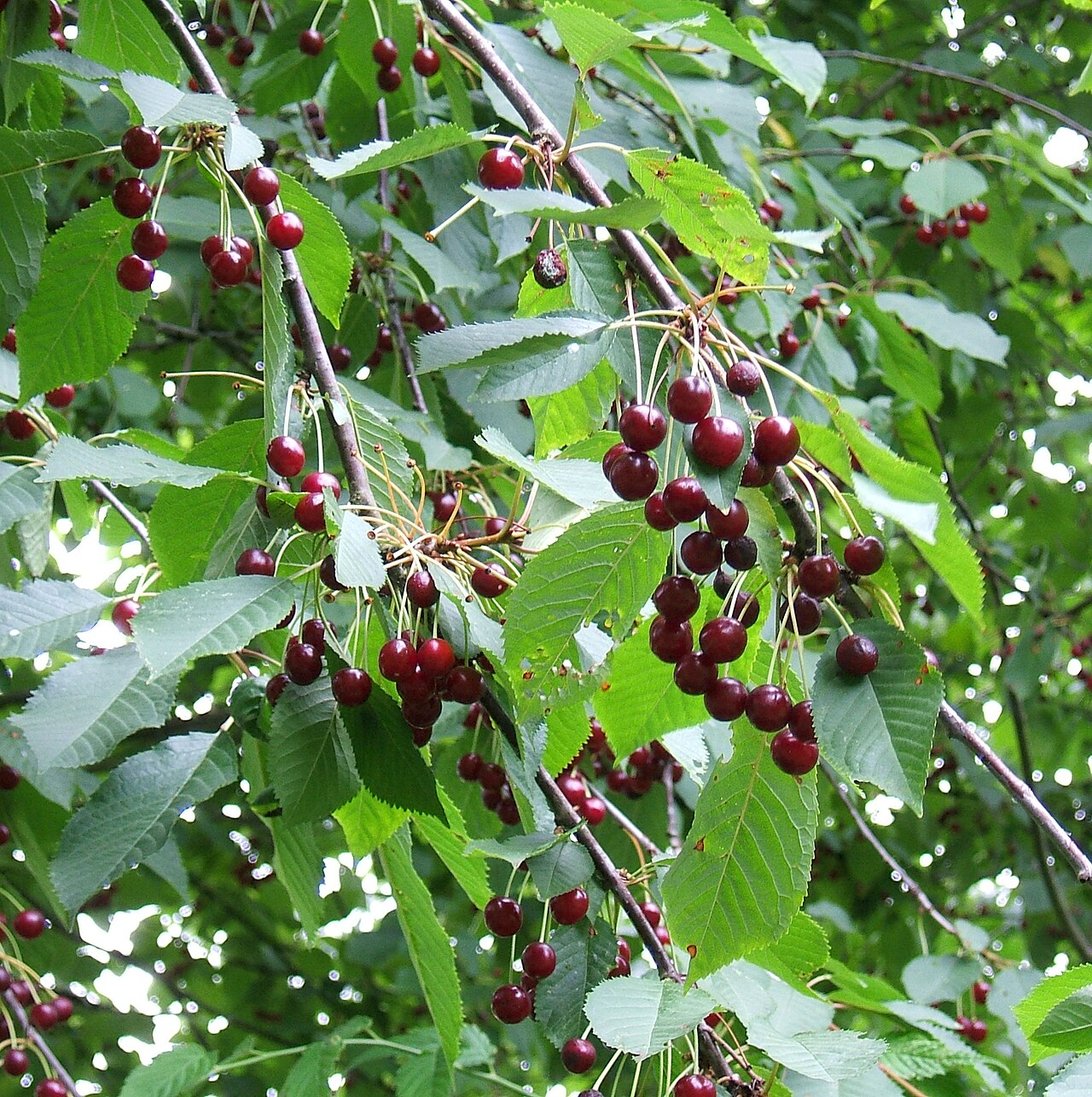
- Difficulty
- Intermediate
- Exhibition
- Sun
- Watering
- Moderate; steady watering in the first summers
- Floor
- Deep, drained, tolerates lime; fears standing water
- Spacing
- 3 to 4 m on Gisela 5, 8 to 10 m on seedling rootstock
- Harvest
- 3 to 4 years on Gisela 5, 6 to 8 years on seedling rootstock
Calendar · Belgian climate
When to sow, plant and harvest
| Activity | Jan | Feb | Mar | Apr | May | Jun | Jul | Aug | Sep | Oct | Nov | Dec |
|---|---|---|---|---|---|---|---|---|---|---|---|---|
| Plantation | yes | yes | yes | yes | yes | |||||||
| Harvest | yes | yes |
Step by step
1Choosing
On Gisela 5, a sweet cherry stays under 3 m and can be covered with netting; on Colt, it reaches 5 m; on wild cherry seedling, it is a giant for a meadow. Sweet cherries are often self-sterile: Sunburst, Lapins and Stella are self-fertile, while Burlat, Kordia and Regina need a companion. The Griotte du Nord, acid, self-fertile and hardy, is the cherry for kriek, for jam and for clafoutis. Prefer a one-year-old bare-rooted maiden.
2Planting
Plant from November to March, outside frosty spells, in deep, drained soil: the cherry tolerates lime but not standing water. Choose a sunny, airy spot, out of frost pockets. The graft union stays clear of the soil. Stake firmly for three years, water generously at planting and mulch over a wide circle. On Gisela 5, space 3 to 4 m; on seedling rootstock, allow 8 to 10 m.
3Caring
Prune the cherry after the harvest, in July or August, never in winter, to avoid gummosis and cankers: take out dead wood and crossing branches, and keep the height down on the small rootstocks. The acid cherry is pruned harder, as it fruits on the current year's wood. Water young trees in summer and mulch. Lay a fine-mesh net as soon as the fruit starts to colour, or share with the blackbirds.
4Harvesting
The cherry does not ripen any further once picked: wait until it is well coloured, glossy and sweet, then pick it with the stalk, without pulling on the May blossom cluster that will carry next year's fruit. Harvest in the morning, in dry weather, as rain splits ripe cherries. Sweet cherries are picked over two or three passes across ten days or so; the acid cherry is picked at the end of July.
5Storing
With its stalk on, the cherry keeps three to four days in the fridge. Stoned and frozen flat on a tray, it goes into clafoutis and winter compotes. Acid cherries keep in vinegar, in syrup or in eau-de-vie, and make jams and coulis. A small surplus of sweet cherries is soon soaked up by a tart; a large one justifies buying a lever-action cherry stoner.
Further reading
Planting and caring for plants properly
How to plant properly
Choosing the rootstock and the form
The rootstock makes the difference between a cherry you pick from a stepladder and a tree whose fruit the blackbirds eat entirely. Gisela 5 keeps the sweet cherry to 2.5 or 3 m and crops from the third year, but calls for a permanent stake, moist soil and thinning; Gisela 6 and Colt give 4 to 5 m and stand on their own feet; Sainte-Lucie tolerates dry, chalky soils; the wild cherry seedling carries the 10 m standards of the meadows. The open-centre bush is the natural form; as a fan against a wall, on Gisela 5, an acid or a sweet cherry is easily trained and covered with netting in five minutes.
Ensuring cross-pollination
Most sweet cherries are self-sterile, and some pairs are incompatible with one another: Burlat and Napoléon, for instance, do not pollinate each other. The self-fertile varieties, Sunburst, Lapins, Stella, Sweetheart and Summit, crop on their own and pollinate almost all the others; if you are planting only one tree, choose one of these. Kordia and Regina, both of high quality, go well with Sunburst or Lapins. The acid cherries, Griotte du Nord, Morel and Montmorency, are self-fertile and do not pollinate the sweet cherries, which flower earlier. Two cherries less than 40 m apart will pollinate each other; a neighbour's tree counts.
Choosing the spot
The cherry wants full sun, a deep, drained soil, chalky if need be, and above all no excess water: in compact clay where water stands in winter, it dies of gummosis and canker within five years. Do the test of a hole filled with water, which should empty within a day; if it does not, plant on a 30 cm mound or choose Colt, which is more tolerant. Avoid frost pockets, since the April flowering is vulnerable, and spots that are too sheltered, where damp lingers on the fruit. A cherry on Gisela 5 is happy with 3 m of width; on seedling rootstock, keep 8 m from buildings and 5 m from the boundary.
Preparing the hole and the soil
Dig 80 cm square and 50 cm deep, breaking up the sides to avoid the pot effect. Mix into the soil two spadefuls of mature compost and a handful of hoof and horn; the cherry, like all stone fruit, takes heavy feeding at planting badly. On acid soil, add a handful of magnesian lime, as the cherry likes lime. On heavy soil, a bed of gravel is no use if it creates a sump: go for the mound instead. Drive in a 2.5 m stake before the tree, essential for the whole life of the tree on Gisela 5, for three years on the others.
Planting bare-rooted
From November to March, outside frosty spells, plant a one-year-old maiden or a young bush bare-rooted: it takes better than a containerised tree and roots out before the first summer. Puddle the roots in a slurry, set the graft union 10 cm above the soil, spread the roots out, fill in, firm, water with 20 litres and mulch over a metre. Cut a maiden back to 70 or 80 cm for an open-centre bush, above five good buds; do not prune a bush that is already formed, or shorten it only slightly. The cherry heals badly: make these planting cuts on a slender maiden, and never on thick wood in winter.
In a pot or container
On Gisela 5, a self-fertile sweet cherry such as Sunburst, Lapins or the dwarf Garden Bing, or a compact acid cherry, does well in a 70 to 80 litre container on a sunny terrace sheltered from the wind. The mix combines garden soil, potting compost and compost over a drainage layer. Water every other day in summer, since a cherry short of water in May drops its fruit, and one given too much water in June splits: regularity matters more than quantity. Organic feed in April, protection for the container in winter, repotting every three years. The great advantage of the container is that netting wraps the whole tree in a moment.
Beginner's mistakes
The first is to plant a cherry on seedling rootstock in a town garden: within ten years it shades everything, can no longer be picked and feeds nothing but the blackbirds. The second is to prune in winter, which brings on gummosis and bacterial canker. Many people also plant a Burlat on its own and wait for fruit that never comes, or a cherry in sodden ground that dies slowly. Finally, forgetting the netting before the fruit colours, then being surprised that everything vanishes in three days, is the most universal mistake of all: on a small rootstock, the net goes on as soon as the cherries turn red.
Look after it properly
Watering in the first years
For the first two summers, water every week in dry weather, 20 to 30 litres at the base, from April to August; on Gisela 5, keep up this attention for the whole life of the tree in a dry summer, as its roots stay shallow. The cherry drinks above all from flowering to harvest, in May and June: a shortage of water makes the young fruit drop, while a sudden watering after a dry spell makes the ripe cherries split. So water regularly, without jolts. After the harvest, a watering every fortnight in a heatwave helps the tree form next year's May blossom clusters.
Mulching and feeding
A 10 cm mulch over a metre across for the first five years removes the competition from grass, to which the cherry is very sensitive. In March, two spadefuls of mature compost and a handful of wood ash are enough; the cherry asks for almost nothing and reacts badly to nitrogen, which brings on gummosis and blackfly. A dressing of magnesian lime every three years on acid soil pleases it. Never put fresh manure at the base. A coat of clay paint on the trunk in winter limits the bark splits caused by swings in temperature, which are common on the cherry.
Pruning: formation, then maintenance
Form the open-centre bush in summer: after the planting cut-back, choose four or five well-spaced main branches in July and remove the others, then shorten them by a third in August for the following two years to make them branch. Once formed, a sweet cherry needs little pruning: after the harvest, in July or August, take out dead wood, crossing branches and water shoots, and cut the too-tall main branches back to a low lateral to keep the tree within reach. Acid cherries fruit on one-year-old wood and are pruned harder, shortening a third of the shoots that have fruited each summer. Seal any wound more than 3 cm across.
Protecting from birds and frosts
Blackbirds, starlings and thrushes spot the cherries before you do. On a tree under 3 m, netting with a 15 to 20 mm mesh laid over a frame of pipes or poles and pegged down at ground level is the only effective protection; put it up at the first colouring and take it off as soon as the harvest is over, so as not to trap the birds. Hanging CDs and scarecrows lose their effect within three days. In spring, a frosty night during flowering can ruin the year: on a small tree, a fleece laid over it in the evening and removed in the morning for the bees saves the flowers down to -3 °C.
Preventing diseases and pests
The cherry fruit fly lays in fruit that colours after mid-June: the early varieties, Burlat and Early Rivers, escape it; for the others, yellow sticky traps from mid-May and fine-mesh netting on a small rootstock limit the damage, and gathering up the fallen fruit breaks the cycle. Drosophila suzukii is now added to the list for the late varieties: harvest promptly and let nothing rot. Blossom wilt, a form of brown rot, dries out the shoots in a wet April: cut them 15 cm below the affected part. Blackfly is dealt with using soft soap in May. Against canker and gummosis, prune in dry weather, never in winter.
Through the season
In February, take off the mummies and paint the trunk; do not prune. In March, compost and mulch, and check the stake ties. In April, throw a fleece over on a frosty night and cut out the shoots wilted by brown rot. In May, put up the yellow traps, water if the month is dry, watch for blackfly. In June, stretch the netting at the first red cherries, pick Burlat around the 10th and Sunburst at the end of the month. In July, pick Kordia and Regina, then the acid cherries; prune after the harvest. In August, water in a heatwave and take the netting off. In October, gather up the leaves if they have carried spots. In November, plant.
Harvesting and storing
The cherry does not ripen any further once picked and gains sugar every day it stays on the tree: wait for the final colour, deep red for Kordia, almost black for Regina, pinkish yellow for Napoléon. Pick with the stalk, pinching it between thumb and forefinger, without tearing off the May blossom cluster that carries next year's fruit. Harvest early in the morning, in dry weather; rain on ripe cherries splits them within hours, which is why it pays to go through the tree every two days. For acid cherries destined for jars, pick with the stalk and deal with them the same day. Freeze them stoned, on a tray.
Obtaining seeds or seedlings
Seeds and seedlings: where to find them
When choosing a fruit tree or shrub, opt for a nursery near you: they stock rootstocks and varieties suited to the local climate, and can advise you on pollination. In Belgium, look for varieties from the Gembloux Research Centre (RGF label); in France, nurseries in the ‘Croqueurs de pommes’ network; elsewhere, collections of regional varieties.
From the vegetable patch to the plate
And then we savour it
What it offers
The cherry provides vitamin C, potassium, fibre and anthocyanins, with a little more sugar than the other soft fruits.
In the kitchen, it’s simple
Clafoutis made with whole cherries, left unstoned for the flavour, remains the simplest and the most eagerly awaited recipe of June.
Living well
A ladder against the cherry tree, a basket and an hour of picking with the family: the best moment of the year in the orchard.
Also worth a look