bulb vegetable · Amaryllidacées
GarlicAllium sativum
Planted in autumn and forgotten all winter, garlic is harvested in July with almost no care at all. It takes up little space, keeps many pests away and stores until the following spring. Fresh garlic from the garden, mild and juicy, has nothing in common with imported dry cloves.
- Difficulty
- Easy
- Exhibition
- Full sun
- Watering
- Very low, only in prolonged spring drought
- Floor
- Light, well drained, without fresh manure or standing moisture
- Spacing
- 10 to 15 cm along the row, 25 cm between rows
- Harvest
- 240 days after autumn planting, 150 days after spring planting
Calendar · Belgian climate
When to sow, plant and harvest
| Activity | Jan | Feb | Mar | Apr | May | Jun | Jul | Aug | Sep | Oct | Nov | Dec |
|---|---|---|---|---|---|---|---|---|---|---|---|---|
| Plantation | yes | yes | yes | yes | ||||||||
| Harvest | yes | yes |
Step by step
1Sowing
Garlic is not sown: it is multiplied from cloves taken from a healthy head. Buy certified seed garlic rather than eating garlic, which is often treated against sprouting or carries disease. Separate the cloves the day before planting, keeping the largest ones from the outside and setting aside those from the centre, which are too small. Do not remove their protective skin.
2Planting out
Plant autumn garlic in October-November and spring garlic in February-March, in light soil that has not received fresh manure. Push each clove in point upwards, three centimetres deep, every ten to fifteen centimetres, in rows twenty-five centimetres apart. In heavy soil, plant on a ridge or drop a handful of sand into the bottom of the hole. Firm and do not water.
3Caring
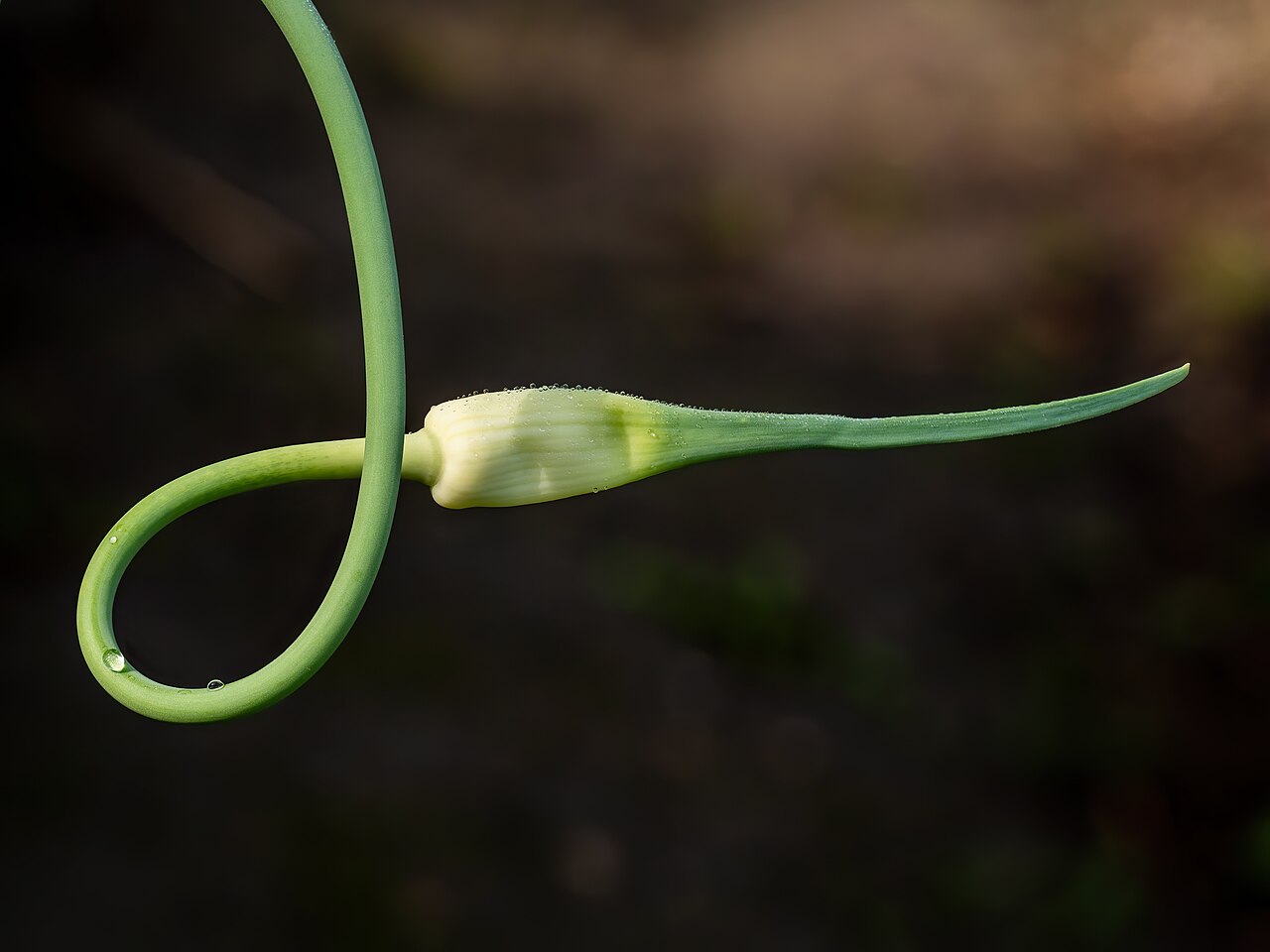
Garlic asks for very little care. Hoe and hand-weed regularly in spring, as its narrow foliage leaves room for weeds. Water only in marked drought in April-May, never after mid-June; moisture at the end of the crop harms storage. Cut the flower stalks of hardneck varieties as soon as they curl: these garlic scapes are delicious sautéed and removing them makes the bulb swell.
4Harvesting
Harvest from late June to July, when the lower third of the leaves has yellowed and dried, on a sunny day. Lift the bulbs with a garden fork without pulling on the stems. Leave them to dry on the ground for two or three days if the weather stays dry, otherwise under an airy shelter. A head harvested too late splits open and keeps badly. Green garlic, picked from May when the bulb is barely formed, gives a mild flavour.
5Storing
Dry the whole heads, leaves still on, for two to three weeks in a dry, airy, shady place. Then plait the supple stems or cut them back to a few centimetres and hang the heads in nets in a dry, cool, dark place, never in the fridge or a damp cellar. Autumn garlic keeps until January, spring garlic until the following spring. Keep the finest heads for planting.
Further reading
Planting and caring for plants properly
How to plant properly
Choosing the spot
Garlic wants the sunniest and best-drained corner of the vegetable garden. A slightly raised bed facing south, with no shade cast in winter when the sun is low, suits it perfectly. Banish hollows where water stands after the November rains: it is excess moisture, far more than frost, that makes garlic fail in Belgium. Also avoid spots where onions, leeks or shallots have grown in the last three years, to cut short rust and white rot. After a crop of beans or cabbages, the spot is ideal.
Preparing the soil
Two to three weeks before planting, loosen the soil to twenty centimetres with a fork or a broadfork, without turning it, and carefully remove bindweed and couch grass roots. Add no fresh manure or young compost: garlic rots in it. In clay soil, mix in two buckets of coarse sand per square metre and raise the bed by ten to fifteen centimetres, or plant on ridges thirty centimetres apart. A handful of sieved wood ash per square metre provides the potash it appreciates. Then let the soil settle before planting.
Choosing and preparing the cloves
Buy seed garlic, guaranteed virus-free, rather than supermarket garlic, which is often unsuited to our climate or treated. Distinguish autumn garlic, white or purple, with larger and earlier heads, from spring garlic, pink or white, which keeps longer. Separate the cloves the day before planting, keeping the six to eight largest from the outside, without removing their skin. The small cloves from the centre give tiny heads: keep them for the kitchen. If you like, soak the cloves for an hour in a warm chamomile infusion, which has antifungal properties.
Planting in autumn or late winter
In Belgium, autumn planting, from 15 October to 30 November, gives the largest heads, as garlic needs two months of cold to divide into cloves. Planting in February-March, safer in heavy soil, gives smaller bulbs that keep until the following spring. Push each clove in point upwards, three centimetres deep, every twelve to fifteen centimetres, in rows twenty-five to thirty centimetres apart. Firm with the flat of the hand and do not water. Mark the rows: emergence takes three to six weeks.
In pots or containers
Garlic does well in a container on a sunny balcony, provided it has twenty centimetres of depth and a very free-draining mix: half potting compost, half sand or pumice, with a layer of clay pebbles at the bottom. Plant five or six cloves per thirty-centimetre container, ten centimetres apart, in October or February. Move the container out of the rain under a canopy in winter, without bringing it into the warm. Water very little, only when the compost is dry deep down. The heads will be smaller than in open ground, but perfect for green garlic in May.
Beginner's mistakes
The most common is planting in rich, freshly manured soil, which guarantees rot. Next comes over-fussing or watering after planting: garlic has no need of it in autumn. Many bury the cloves too deep or upside down, which delays emergence by a month. Planting supermarket cloves, often from the south, gives plants that run to flower without forming a head. Finally, replanting in the same spot every year invariably ends up establishing rust and white rot for years to come.
Look after it properly
Watering almost never
From planting to mid-April, garlic makes do with rain, which is always sufficient here. After that, water only if three weeks go by without rain while the bulbs are forming, in April-May, at the rate of one watering can for two metres of row, at the base, in the morning. Stop completely from mid-June, when the lower leaves yellow: moisture at the end of the crop splits the heads and compromises storage. If the summer is wet, a light tunnel or a simple sheet of plastic stretched over the rows for the last few weeks preserves the quality of the bulbs.
Hoeing, weeding, not mulching
Garlic's narrow foliage never covers the soil, and weeds quickly get the upper hand in spring. Hoe between the rows every two weeks from March to June, and pull chickweed and speedwell by hand at the base of the plants. Avoid thick mulch, which holds moisture at the neck and shelters slugs. A thin layer of dried grass clippings or flax mulch, one centimetre deep, is tolerable in sandy soils. No fertiliser is useful; at most, a little sieved wood ash in March for potash, never nitrogen.
Cutting the garlic scapes
Hardneck varieties, such as purple or pink garlic, send up a flower stalk in June that curls into a spiral. Cut it as soon as it has looped, before the bulbil head swells, with scissors, level with the upper leaves. Removing it diverts energy to the bulb, which grows by a third. These scapes are a vegetable in their own right: sautéed in butter, in pesto or pickled, they have a mild, green flavour. On softneck garlic, such as the white autumn varieties, there is nothing to do; these are the ones you plait.
Preventing rust and rots
Rust, orange pustules that spot the leaves in a wet spring, is the most common disease. It does not destroy the harvest but reduces the size of the bulbs. Space the plants well, avoid stuffy shelters, cut off and remove affected leaves, spray horsetail decoction every ten days from April and harvest a little earlier if it spreads. White rot, a cottony felt at the neck, is more serious: pull up, bin and grow no alliums in that spot for eight years. Fine mesh from April to June blocks the onion fly.
Through the season
In October-November, plant and mark the rows. In December-January, do nothing, other than replace cloves lifted by frost or birds. In February-March, plant spring garlic, hoe for the first time and add a little ash. In April-May, hoe every two weeks, lay mesh against the fly, watch for rust and water only in drought. In June, cut the scapes, stop all watering and harvest fresh green garlic. In July, harvest, dry and sort. In August-September, plait and store, setting the finest heads aside for planting.
Harvesting at the right stage
The right moment comes from late June to mid-July for autumn garlic, around late July for spring garlic, when the three or four lowest leaves are dry and the upper leaves are still green. Each green leaf corresponds to a protective skin around the head: wait too long, and the skins tear, the head splits and no longer keeps. Lift with a fork in dry weather, without pulling, and do not wash the soil off with water. A simple test: dig up a head and cut it in half; if the cloves are well defined and fill the skin, it is time.
Drying, plaiting and extending
Dry the whole heads, leaves and roots still on, for two to three weeks in the shade in an airy place, hung in bunches of ten or spread on a rack. Then cut roots and stems back to two centimetres, or plait the still-supple stems of softneck varieties. Store between 10 and 18 °C, dry and in the dark, never in a damp cellar or the fridge, where garlic sprouts. Autumn garlic keeps until January, spring garlic until April-May. To bridge the late-winter gap, pot up a few cloves in December: their green leaves add flavour like chives.
Obtaining seeds or seedlings
Seeds and seedlings: where to find them
A selection of reputable seed suppliers that deliver to your country, listed in order of proximity. Evadya does not receive any commission: these are suppliers we recommend for their reliability.
Semailles
For Belgian artisan seed producer, organic and reproducible seeds, over 250 regional varieties, a planting calendar tailored to the Belgian climate.
Against Small organisation: limited range of hybrid varieties and possible stock shortages during peak season.
Search for ‘garlic’ on SemaillesKokopelli
For Europe’s largest collection of heirloom, organic and open-pollinated varieties; comprehensive growing guides.
Against No hybrids or seedlings; delivery times can sometimes be long during peak season; prices are slightly higher.
View the shopFerme de Sainte Marthe
For A long-established organic seed supplier, offering seeds and young plants, heirloom varieties, and nutrition and recipe guides.
Against Dispatched from the Loire: postage charges to Belgium and Switzerland; plants are fragile in transit.
Search for ‘garlic’ on Ferme de Sainte MartheGraines Baumaux
For A vast selection (over 500 tomato varieties), with high-yielding F1 hybrids and heirloom varieties side by side, and plants available in season.
Against Not much organic produce; an old site; catalogue entries rather than growing guides.
Search for ‘garlic’ on Graines BaumauxVreeken’s Zaden
For A very wide range of Dutch products, competitive prices, and numerous varieties suited to the Benelux climate.
Against Website in Dutch only; limited selection of organic produce.
Search for ‘garlic’ on Vreeken’s ZadenDe Bolster
For Dutch organic seed producer, seeds suitable for propagation, a good selection for cool climates.
Against A shorter catalogue; website in Dutch.
Search for ‘garlic’ on De BolsterZollinger Bio
For Swiss organic seeds, varieties suited to high altitudes and microclimates, and a unique phenological calendar.
Against Swiss prices and customs charges from the European Union.
Search for ‘garlic’ on Zollinger BioBingenheimer Saatgut
For A leading German name in organic and biodynamic produce, offering open-pollinated varieties selected for the home gardener.
Against Website in German; delivery charges apply outside Germany.
Search for ‘garlic’ on Bingenheimer SaatgutDreschflegel
For A collective of organic growers, specialising in rare and regional varieties, and the preservation of traditional farm seeds.
Against Small quantities; a catalogue that’s more activist than practical; website in German.
Search for ‘garlic’ on DreschflegelFrom the vegetable patch to the plate
And then we savour it
What it offers
Garlic is rich in sulphur compounds, including allicin, in antioxidants and in manganese. Used in small amounts, it lifts dishes and reduces the need for salt.
In the kitchen, it’s simple
Fresh June garlic, its bulb still tender, is slowly confited in olive oil to be crushed onto toasted bread or slipped into a mash.
Living well
Planting garlic around All Saints' Day, when the vegetable garden is emptying, is already sowing a promise for the summer to come.
Also worth a look
Other vegetables
Onion
Allium cepa
Shallot
Allium cepa var. aggregatum
Florence fennel
Foeniculum vulgare var. azoricum
Tomato
Solanum lycopersicum