fruit tree · Moracées
FigFicus carica
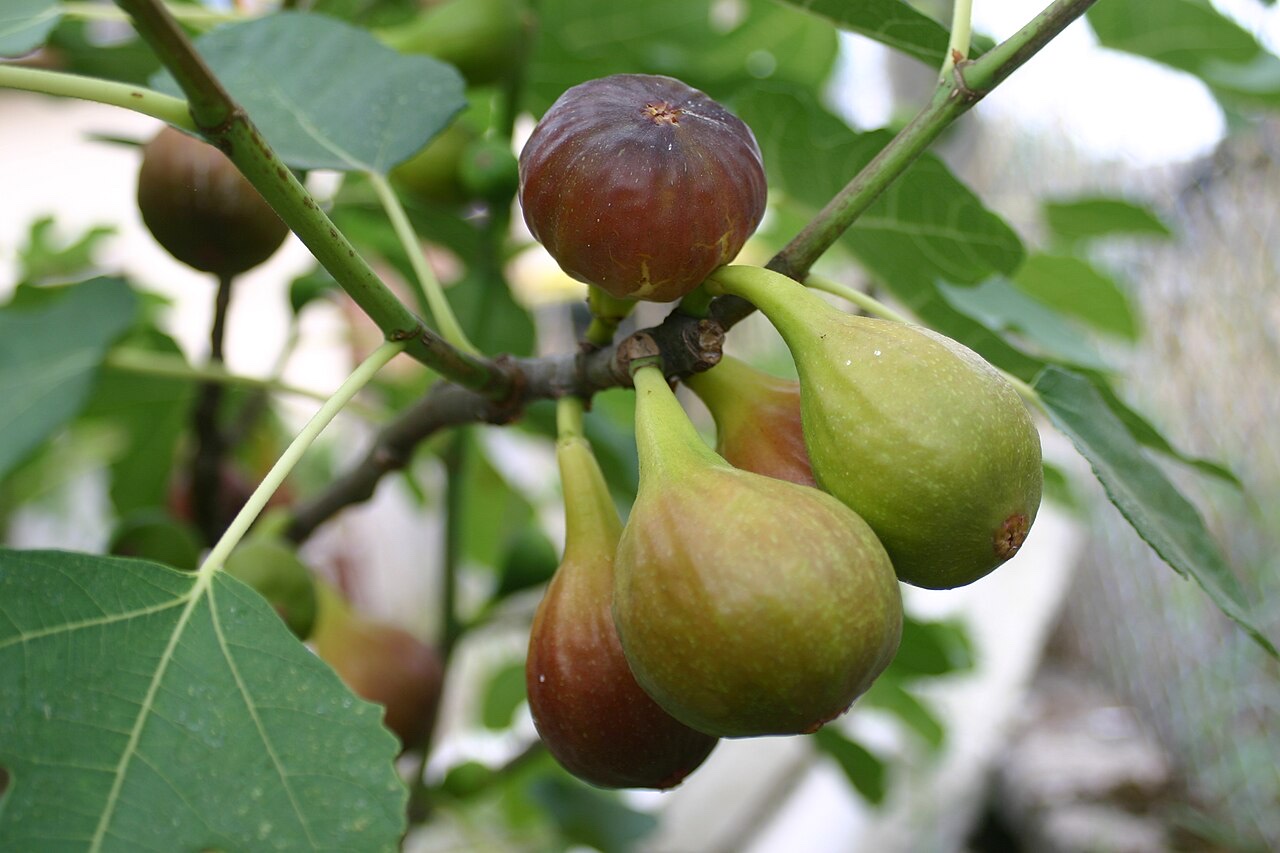
The fig tree sets you dreaming of the Mediterranean, and yet it fruits in Belgium against a south-facing wall, in a pot or in a cold glasshouse. With an early variety and a little patience, you will pick sweet, thin-skinned figs in September that stand no transport at all and that only the garden can offer.
- Difficulty
- Intermediate
- Exhibition
- Full sun, south-facing wall
- Watering
- Moderate; regular in a pot, heavier in a dry summer
- Floor
- Drained, stony or chalky, not rich
- Spacing
- 3 to 4 m in open ground, or a 60-litre container
- Harvest
- 2 to 3 years after planting
Calendar · Belgian climate
When to sow, plant and harvest
| Activity | Jan | Feb | Mar | Apr | May | Jun | Jul | Aug | Sep | Oct | Nov | Dec |
|---|---|---|---|---|---|---|---|---|---|---|---|---|
| Plantation | yes | yes | ||||||||||
| Harvest | yes | yes | yes |
Step by step
1Choosing
In Belgium, only the autumn crop, carried on the current year's wood, ripens reliably: choose an early, self-fertile variety suited to the north. Ronde de Bordeaux, small, sweet and very early, is the best candidate; Brown Turkey, Dalmatie and Longue d’Août also do well. Madeleine des deux saisons sometimes gives a breba crop in July. Buy a container-grown plant, well branched, of two or three years.
2Planting
Plant in spring, in April or May, against a south-facing wall that gives back its warmth at night. The fig likes a drained soil, even stony and chalky; enrich it moderately with compost. Restrict the roots with slabs sunk 60 cm deep or plant in a large 60-litre container: a fig tree kept in check fruits sooner and grows less. Space at 3 to 4 m, water generously in the first year, mulch with gravel.
3Caring
For the first two winters, protect the base with a thick mulch and the branches with a fleece or straw: young wood freezes around -10 °C, but the stool always comes back. Prune in March, lightly, to let air in and shorten over-long branches; the autumn figs are born on the current year's shoots. In a pot, water without excess but regularly, repot every three years and bring it into a light garage as soon as hard frosts arrive.
4Harvesting
The fig is ripe when it bends on its stalk, softens, sometimes splits and lets a drop of honey bead at the eye. It does not ripen after picking: wait for the right moment, then detach it gently with the stalk. The harvest runs from August to early October depending on variety and warmth. Figs still green in October will never ripen, apart from those the size of a pea, which will give the breba crop.
5Storing
A ripe fig keeps two or three days in a cool place, no more. The surplus becomes jam, chutney, figs roasted in the oven or dried slowly in a dehydrator. The green end-of-season figs, unripened, can be candied in syrup or go into a sweet-and-sour chutney. The foliage, highly scented, flavours a syrup or an infused cream. Nothing is wasted on a fig tree, even in a cool climate.
Further reading
Planting and caring for plants properly
How to plant properly
Choosing a variety suited to the north
In Belgium, the fig is grown on its own roots, never grafted, and the variety does everything. Single-cropping figs produce one harvest only, in late summer, on the current year's wood: it is the only one that ripens reliably here. Ronde de Bordeaux, a small, very early and sweet purple fig, is the best candidate, followed by Brown Turkey, Dalmatie with its large green fruit and Longue d’Août. Twice-cropping varieties such as Madeleine des deux saisons or Pastiliere also give a breba crop in July, on the previous year's wood, if the winter has been mild. All are self-fertile. Buy a two- or three-year-old plant, well branched, in a container.
Choosing the south-facing wall
The fig needs stored warmth: a brick or stone wall facing due south, sheltered from the east winds, which radiates at night what it took in during the day. The corner of two walls, a paved yard, a flagged terrace gain another two degrees. Avoid the north, the windy west and frost pockets; in the Ardennes or above 300 m, stay with a pot. Plant 50 cm from the wall, training the branches as a fan on wires fixed every 40 cm: a fig trained this way takes 3 m across and 2.5 m high, ripens two weeks earlier and is easily protected in winter.
Preparing the soil and restricting the roots
The fig likes a drained soil, even poor, stony or chalky; in rich, moist earth it makes large leaves and figs that do not ripen. Dig 60 cm square and 50 cm deep, put 15 cm of rubble or gravel in the bottom, and fill with a mix of garden soil, coarse sand and one spadeful of compost only. Restrict the roots by lining the sides with concrete slabs or slates sunk 60 cm vertically, or with a bottomless container: a fig kept in check fruits sooner, grows less and stands the cold better. That is the secret of the old town fig trees.
Planting in spring
Plant in April or May, never in autumn: a young fig planted before winter has no time to root and freezes. Soak the rootball, tease it out, set the crown at soil level, against the wall, leaning the plant slightly towards its wires. Fill in, firm, water with 15 litres, mulch with gravel or crushed slate, which stores heat, rather than straw. Select three to five well-placed branches for the fan and remove the others at the base; shorten the branches you keep by a third above an outward-facing bud. Water every week through the whole first summer.
In a pot or container
This is the ideal solution for half the country: a fig in a 50- to 60-litre container, in a mix of garden soil, potting compost and sand over a bed of gravel, produces very well, because its restricted roots push it to fruit. Choose Ronde de Bordeaux, Brown Turkey or the dwarf Little Miss Figgy. On castors, the container spends the summer against a south-facing wall and the winter in a garage or a cold shelter, light or not, where the leafless fig sleeps from November to March with a monthly watering. Bring it out in April, water every other day in summer, feed in May and June, repot every three years trimming the rootball.
Beginner's mistakes
The first is to plant a fig in rich, shaded ground, or to expect two harvests from it: it grows enormously and the figs stay green in October. The second is to choose a variety from the south, Marseillaise or Sultane, too late for our summers. Many people also plant in October, or leave a young specimen unprotected through the first winter, then find a fig frozen to the ground which does come back, certainly, but loses two years. Finally, an excess of water and nitrogen: a well-treated fig makes leaves; a fig kept in check, a little starved, at the foot of a warm wall, makes figs.
Look after it properly
Watering without excess
In the first summer, water every week, 15 litres, as the fig has not yet made its deep roots. After that, in open ground at the foot of a wall, a watering every fortnight in July and August in dry weather is enough; an excess gives bland figs that split. In a container, the opposite is true: the compost dries quickly and the large leaves wilt in an afternoon; water every other day in summer, every day in a heatwave, but let the surface dry out in between. Stop all heavy watering as soon as the figs begin to soften, to concentrate the sugar and avoid splitting.
Mulching and feeding
Mulch with gravel, pebbles or crushed slate over a metre, which warms the soil and keeps damp away from the crown; an organic mulch suits a container. Feeding stays light: a spadeful of mature compost and a handful of wood ash in April, nothing more in open ground. In a container, a complete organic fertiliser in May and June, stopped in July so that the wood can ripen. Ban nitrogen in all its forms, including nettle liquid: a well-fed fig makes two-metre shoots that freeze in winter and carry nothing. A fig that grows less than 40 cm a year is a fig that produces.
Pruning as a fan and pinching out
The single-cropping fig fruits on the current year's shoots: pruning is done in March, after the hard weather, when the buds swell. On the fan, keep five to seven framework branches tied to the wires, remove those heading towards the wall or forwards, cut out frozen wood, black at the cut, back to sound wood, and shorten over-long branches by a third to a well-placed bud. In June, pinch the new shoots at five or six leaves: this slows the growth, ripens the wood, exposes the figs to the sun and brings ripening forward by two weeks. In a container, prune shorter to stay within 1.5 m.
Overwintering and protecting from frost
A mature fig against a wall withstands -12 °C; young plants and shoot tips freeze from -8 °C. For the first three winters, earth up the base by 30 cm with soil, dry leaves or straw held by wire netting, and wrap the branches in a double winter fleece or reed screens, never in plastic, which condenses. Remove the protection in March in mild weather. A fig frozen to the ground comes back from the stool in spring and fruits again two years later: do not grub it out before June. In a container, bring it into a frost-free shelter or wrap the pot in bubble wrap and the foliage in fleece.
Preventing diseases and pests
The fig has almost no enemies in our climate. Fig rust spots the leaves orange in September in a damp summer; gather up the fallen leaves, with no other treatment. Scale insects can settle on a container specimen overwintered indoors: go over the branches with soft soap and alcohol in March. Ants, wasps and blackbirds fight over the ripe figs: pick every day and bag the finest in an organza bag. A fig that runs with white sap after pruning is not diseased; this latex irritates the skin, so wear gloves and prune in dry weather.
Through the season
In March, remove the protection, prune, compost lightly; bring the container out. In April, still use a fleece on frosty nights, the young leaves are tender. In May, admire the breba figs on the twice-cropping varieties, water the container. In June, pinch the shoots, water the container every other day. In July, one watering in open ground if it is dry, pick the breba figs. In August-September, harvest every day, cut back the water. In October, remove the figs that will never ripen, apart from the tiny embryos. In November, earth up and wrap, bring the container in after leaf fall. In winter, let it sleep.
Harvesting and storing
A ripe fig is judged not by its colour but by how it holds itself: it bends on its stalk, its neck softens, its skin crazes finely and a drop of sugar sometimes beads at the eye. Pick in the morning, while it is still cool, detaching it with its stalk in a slight sideways movement; a fig that resists is not ready. It does not ripen after picking and keeps two days in a cool place, on a plate, without being stacked. The last October figs left green can be candied in syrup. The branches pruned in March give leaves to flavour a syrup or a panna cotta.
Obtaining seeds or seedlings
Seeds and seedlings: where to find them
When choosing a fruit tree or shrub, opt for a nursery near you: they stock rootstocks and varieties suited to the local climate, and can advise you on pollination. In Belgium, look for varieties from the Gembloux Research Centre (RGF label); in France, nurseries in the ‘Croqueurs de pommes’ network; elsewhere, collections of regional varieties.
From the vegetable patch to the plate
And then we savour it
What it offers
The fresh fig supplies fibre, potassium and calcium, with a natural sweetness that pleases anyone with a sweet tooth.
In the kitchen, it’s simple
Figs cut in a cross, given a few minutes in the oven with a little honey and thyme, go with a goat's cheese or an ice cream.
Living well
Eating a warm fig, picked from your own tree in Brussels or Liège, tastes of a small victory over the climate.
Also worth a look