herb · Lamiacées
ThymeThymus vulgaris
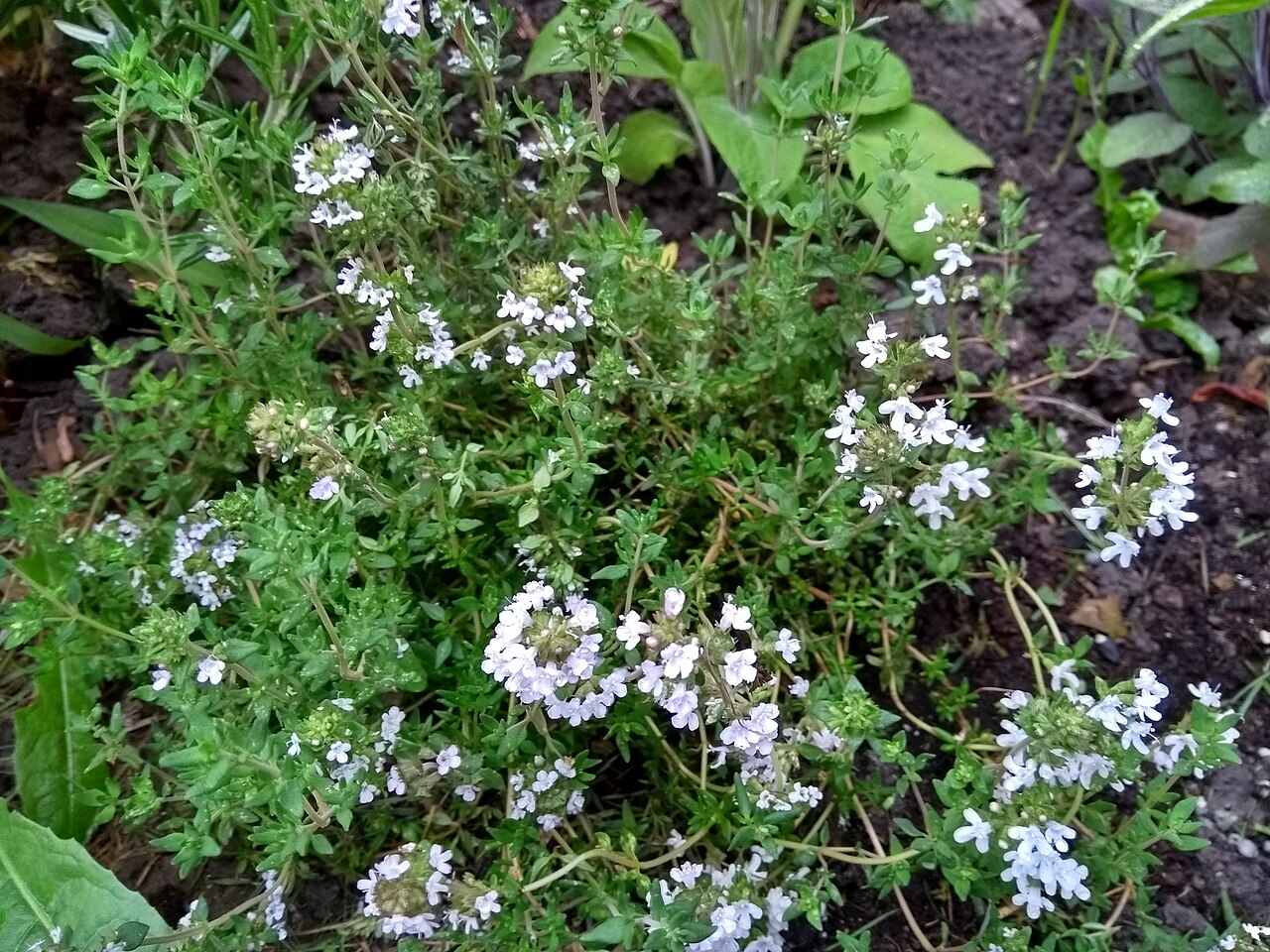
A small shrub from the south of France, thyme settles in very well here provided it has sun and soil that drains. Once established, it asks for nothing, can be picked all year round and flowers in June for the bees. It is the herb of stews, roasts and winter herbal teas.
- Difficulty
- Easy
- Exhibition
- Full sun
- Watering
- Very moderate; only at planting and in prolonged drought in the first year.
- Floor
- Poor, light, chalky, very well-drained soil; dreads standing moisture in winter.
- Spacing
- 30 cm between plants.
- Harvest
- First picking 3 to 4 months after planting.
Calendar · Belgian climate
When to sow, plant and harvest
| Activity | Jan | Feb | Mar | Apr | May | Jun | Jul | Aug | Sep | Oct | Nov | Dec |
|---|---|---|---|---|---|---|---|---|---|---|---|---|
| Sowing under cover | yes | yes | ||||||||||
| Sowing in open ground | yes | yes | ||||||||||
| Plantation | yes | yes | yes | yes | ||||||||
| Harvest | yes | yes | yes | yes | yes | yes | yes | yes | yes | yes | yes | yes |
Step by step
1Sowing
Sow in March-April under cover or in April-May outdoors, in a seed tray or pots, on light compost mixed with sand. The seeds are tiny: set them on the surface, firm and cover with a dusting of fine sand. Germination in two to three weeks at 18 °C. Sowing is slow; a cutting in June or buying a plant gives a quicker result.
2Planting
Plant in April-May or September-October, every 30 cm, in full sun, in a hole lightened with sand or gravel, without compost. Firm and water once to settle it in. Thyme is happy along the edge of paving, in a rockery, in a herb spiral or in a terracotta pot with crocks at the bottom. Bought plants divide easily.
3Caring
Weed around the young plants and water only in drought in the first year. After that, leave it alone: no fertiliser, no watering. Trim lightly after flowering, in July, without cutting into old wood, to keep a compact clump that does not go bare. A mineral mulch of gravel at the base limits moisture at the crown in winter.
4Harvesting
Cut sprigs of 5 to 10 cm with scissors, all year round, taking from the whole clump rather than from one spot. The scent is at its peak just before and during flowering, in June: that is the moment for the year's harvest for drying, on a dry morning, once the dew has gone. Avoid stripping the plant too hard at the end of winter.
5Storing
Thyme is one of the few herbs that improve with drying: hang the bunches upside down in a dark, airy room, then strip the leaves into a sealed jar, away from light, for a year of scent. It also freezes as sprigs. Fresh, it lasts a week in the fridge. A few branches in a bottle of oil or vinegar flavour them lastingly.
Further reading
Planting and caring for plants properly
How to plant properly
Choosing the spot
Thyme wants what our climate offers least: sun all day and soil that does not hold water. Give it the warmest, driest spot in the garden, a south-facing bank, the top of a rockery, the summit of a herb spiral, the foot of a light-coloured wall, the edge of a paved terrace whose stones give back heat. Shun hollows, compact clays and the shade of trees, where it languishes and then rots in winter. Away from thirsty plants, it gets on well with rosemary, sage, lavender and strawberries.
Preparing the soil
Thyme grows in the garrigue: add neither compost nor manure, which would make it soft and scentless. In our loamy or clay soils, dig a hole 30 cm deep, mix the soil taken out with an equal volume of coarse sand, fine gravel or brick chippings, and raise the whole into a mound 10 to 15 cm above ground level. A handful of lime or wood ash reminds it of its native chalky soils. A layer of gravel on the surface, around the crown, will finish the job after planting by keeping moisture at bay.
Sowing or taking cuttings
Sowing is possible in March-April indoors, at 18 °C, in a seed tray of compost mixed half and half with sand; the tiny seeds are set on the surface and covered with a dusting of sand. Germination in two to three weeks, plants ready to go out in June, harvest the following year. Quicker and truer to type, cuttings are taken in June: take 8 cm non-flowering tips, strip the lower half of leaves, push them into a pot of damp sand under a plastic bag, in the shade; they root in three weeks. Layering a low branch, pegged down and covered with soil, is simpler still.
Choosing the plant
At the garden centre, choose a compact plant, branched from the base, with dense foliage and no bare stems, in a pot whose roots are not yet coming out. A tall, bare thyme, forced in a heated greenhouse, will establish badly. Rub a leaf: the scent should be strong. Common thyme, Thymus vulgaris, is the hardiest and the most useful in the kitchen; lemon thyme, a little less resistant, deserves a pot to bring under the eaves; creeping wild thyme carpets a rockery. A garden centre plant often divides into two or three at planting, which makes an edging at little cost.
Planting on a mound
Plant in April-May, when the soil is warming up, or in September to let autumn settle the roots before winter, every 30 cm. Make a hole in the prepared mound, remove from the pot, tease out circling roots, and set the plant so that the crown sits slightly above the soil. Fill in with the sandy mix, firm well and water only once, two litres, to settle it in. Then spread 2 cm of gravel or sand around the base. Young spring plants need weekly watering if it is dry until July, then nothing more.
In a terracotta pot
A pot is often the best choice in Belgium, because it lets you keep thyme dry under the eaves or against a south-facing wall. Choose terracotta, which breathes, a pot of at least 20 cm, with a hole, and 5 cm of crocks or clay pebbles at the bottom. Fill with a mix of half potting compost and half coarse sand or lightened garden soil, without compost. No saucer. Water when the mix is dry right through, once a week in summer, almost never in winter. Repot every three years in March into a pot only slightly larger.
Beginner's mistakes
The most common is treating thyme like a vegetable: compost, rich potting mix, daily watering, a full saucer. It dies in one winter, drowned rather than frozen. The second is planting it in clay soil without lightening it, at ground level, in a damp corner. The third is letting a clump age without trimming, until it goes bare in the centre and no longer regrows. Finally, bringing thyme into the warm for winter makes it wither: it needs coolness and light, not heating. A pot under the eaves, outside, gets through winter far better than a kitchen.
Look after it properly
Watering almost never
A thyme established for a year is never watered again in open ground, even during our August heatwaves: its deep roots and tiny leaves are made for drought, and summer watering mainly encourages rot at the crown. Only the young plant, in its first season, gets a litre a week if the weather is dry. In a pot, wait until the mix is dry through its whole depth, lifting the pot to judge its weight: once a week in summer, once a month in winter, in the morning, without wetting the foliage. A grey, limp thyme has too much water, never too little.
Mineral mulch, no feeding
The only mulch that suits thyme is mineral: gravel, coarse sand, slate chippings or volcanic grit 2 to 3 cm deep, which keep the crown dry, reflect heat and prevent soil splashes. Organic mulches, grass clippings, straw or leaves, hold moisture and rot it in winter. No fertiliser is needed; a fed thyme produces long, soft, scentless stems. At most, every two or three years in March, a handful of wood ash or lime at the base maintains the chalk it appreciates. Weed by hand, without deep hoeing, so as not to injure the shallow roots.
Trimming to keep the clump
Trimming is the only care that matters. After flowering, in July, cut the whole clump back by a third with shears, in a rounded shape, always staying within the leafy parts: thyme does not regrow from bare old wood. A second light trim in September, without touching the wood, tightens the clump before winter. Never trim in late autumn or winter, as the wounds would freeze. Despite this care, a plant goes bare after five or six years: prepare its successors by taking a few tip cuttings every June, or layering the low branches, to replace old plants as you go.
Preventing diseases and pests
Thyme has practically no pests, as its scent keeps them away. Its only real threat is rot of the roots and crown during our wet winters, prevented by the mound, the sand, the gravel and the total absence of compost. Foliage browning in patches in February signals excess water or heavy snow that stayed too long; cut out the dead parts in April and let it regrow. Slugs shun mature thyme but nibble cuttings. Mealybugs sometimes appear on a pot brought into the warm; a cotton bud dipped in alcohol or a spray of soft soap is enough.
Through the season
March, removal of dead shoots, repotting if needed, a little lime. April-May, planting new plants, watering young plants only. June, flowering, visits from the bees, big harvest for drying just before the flowers open, cuttings for the next generation. July, trimming by a third after flowering. August, nothing, except picking. September, autumn planting, light shaping trim. October, moving pots under the eaves, on blocks. November to February, occasional picking in dry weather; a fleece laid over plants in open ground when a frost below -12 °C is forecast, removed as soon as it turns milder.
Harvesting and overwintering
Pick all year round, with scissors, sprigs of 5 to 10 cm taken by working round the clump, never stripping one side or cutting down into the wood. The harvest for storing is done on a dry June morning, just before full flowering, when the essential oils are at their peak. In winter, thyme stays green and can be picked in dry weather, but reduce picking from December to February, as it does not regrow. Common thyme withstands -15 °C in drained soil; lemon thyme gives up around -8 °C and spends winter in a pot, under the eaves or in a bright, cold garage, watered once a month.
Obtaining seeds or seedlings
Seeds and seedlings: where to find them
A selection of reputable seed suppliers that deliver to your country, listed in order of proximity. Evadya does not receive any commission: these are suppliers we recommend for their reliability.
Semailles
For Belgian artisan seed producer, organic and reproducible seeds, over 250 regional varieties, a planting calendar tailored to the Belgian climate.
Against Small organisation: limited range of hybrid varieties and possible stock shortages during peak season.
Search for ‘thyme’ on SemaillesKokopelli
For Europe’s largest collection of heirloom, organic and open-pollinated varieties; comprehensive growing guides.
Against No hybrids or seedlings; delivery times can sometimes be long during peak season; prices are slightly higher.
View the shopFerme de Sainte Marthe
For A long-established organic seed supplier, offering seeds and young plants, heirloom varieties, and nutrition and recipe guides.
Against Dispatched from the Loire: postage charges to Belgium and Switzerland; plants are fragile in transit.
Search for ‘thyme’ on Ferme de Sainte MartheGraines Baumaux
For A vast selection (over 500 tomato varieties), with high-yielding F1 hybrids and heirloom varieties side by side, and plants available in season.
Against Not much organic produce; an old site; catalogue entries rather than growing guides.
Search for ‘thyme’ on Graines BaumauxVreeken’s Zaden
For A very wide range of Dutch products, competitive prices, and numerous varieties suited to the Benelux climate.
Against Website in Dutch only; limited selection of organic produce.
Search for ‘thyme’ on Vreeken’s ZadenDe Bolster
For Dutch organic seed producer, seeds suitable for propagation, a good selection for cool climates.
Against A shorter catalogue; website in Dutch.
Search for ‘thyme’ on De BolsterZollinger Bio
For Swiss organic seeds, varieties suited to high altitudes and microclimates, and a unique phenological calendar.
Against Swiss prices and customs charges from the European Union.
Search for ‘thyme’ on Zollinger BioBingenheimer Saatgut
For A leading German name in organic and biodynamic produce, offering open-pollinated varieties selected for the home gardener.
Against Website in German; delivery charges apply outside Germany.
Search for ‘thyme’ on Bingenheimer SaatgutDreschflegel
For A collective of organic growers, specialising in rare and regional varieties, and the preservation of traditional farm seeds.
Against Small quantities; a catalogue that’s more activist than practical; website in German.
Search for ‘thyme’ on DreschflegelFrom the vegetable patch to the plate
And then we savour it
What it offers
A herb rich in essential oils, including thymol, and in antioxidants, traditionally used as an infusion.
In the kitchen, it’s simple
A sprig in a carbonade or a rabbit in beer, or fresh thyme on roast potatoes with garlic in its skin.
Living well
An infusion of garden thyme with a spoonful of honey, on a November evening, is a simple and comforting ritual.
Also worth a look