soft fruit · Éricacées
BlueberryVaccinium corymbosum
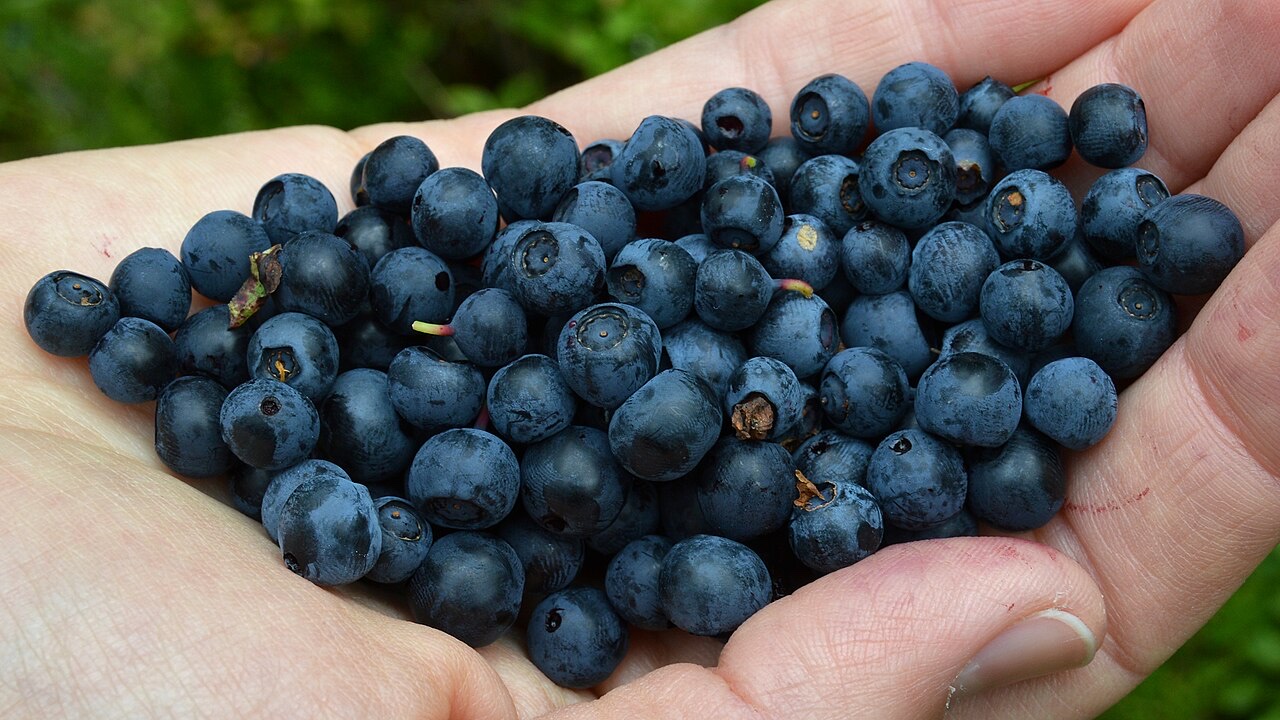
The cultivated blueberry, American cousin of our wild bilberry, makes a handsome shrub with blazing autumn foliage and covers itself in summer with large bluish berries. It asks only one thing: a frankly acid soil. Give it that and you will be harvesting for thirty years.
- Difficulty
- Intermediate
- Exhibition
- Sun or partial shade
- Watering
- Rainwater only, soil always moist
- Floor
- Acid (pH 4 to 5.5), light, humus-rich, drained
- Spacing
- 1.2 to 1.5 m between shrubs
- Harvest
- A few berries in the 2nd year, worthwhile production after 4 or 5 years
Calendar · Belgian climate
When to sow, plant and harvest
| Activity | Jan | Feb | Mar | Apr | May | Jun | Jul | Aug | Sep | Oct | Nov | Dec |
|---|---|---|---|---|---|---|---|---|---|---|---|---|
| Plantation | yes | yes | yes | yes | ||||||||
| Harvest | yes | yes | yes |
Step by step
1Choosing
Choose highbush blueberries, the only ones to give large berries in the garden. Bluecrop remains the safe bet; Duke, early, and Elliott, late, stretch the season into September. Blueberries are partly self-fertile, but two varieties side by side give bigger and more numerous fruit. Buy two- or three-year-old plants in containers, with several stems, from a grower who knows the species.
2Planting
Test your soil first: it needs a pH of 4 to 5.5. On neutral or chalky ground, plant in a 60 cm pit or in a large container filled with ericaceous compost, composted pine bark and coir. Plant in spring or autumn, space 1.2 to 1.5 m apart, water with rainwater and mulch with pine bark or conifer needles, which keep the soil acid.
3Caring
Watering is done exclusively with rainwater, as hard tap water pushes the pH up: plan for a water butt. Keep the soil moist in summer, as the plant has shallow roots. For the first three years, prune hardly at all; then, every winter, remove one or two old branches at the base along with the spindly shoots. A fertiliser for ericaceous plants in spring is enough. Renew the bark mulch every year.
4Harvesting
A blue berry is not necessarily ripe: wait four to seven days after the colour change, until it comes away by rolling under your fingers and the face next to the stalk is blue and not reddish. Harvest in successive passes, every week, from July to September depending on the variety. A net is essential against blackbirds and thrushes, which are very fond of them.
5Storing
Firm and protected by its bloom, the blueberry keeps a good week in the fridge, unwashed. It freezes perfectly loose and stays whole when thawed, ideal for muffins, compotes and crumbles. Dried, it replaces raisins. Jam needs little cooking; the juice, pasteurised, keeps its deep colour for several months.
Further reading
Planting and caring for plants properly
How to plant properly
Choosing the varieties and pairing them
The highbush blueberry is planted as a bush on its own roots, never grafted, which makes it simple to manage. Always pair two or three varieties: cross-pollination by bumblebees increases both the size and the number of berries. A combination proven in Belgium brings together Duke, early in the first days of July, Bluecrop, mid-season and very reliable, and Elliott or Chandler to finish in September. Choose two- or three-year-old plants in containers of at least three litres, branched from the base, never a single-stemmed plant that will take two more years to produce.
Checking the acidity of the soil
Before buying anything, measure the pH with a garden centre kit or a laboratory test: it must be between 4 and 5.5. The soils of the Campine and the Ardenne are naturally so; the loams of Hesbaye, Brabant and Hainaut sit between 6.5 and 7.5 and will not do without work. A simple clue: if rhododendrons, heathers or ferns grow spontaneously in the neighbourhood, the blueberry will succeed. On chalky soil, granular sulphur lowers the pH by about half a point a year, too slowly for an immediate planting: go through the pit or the container instead.
Digging an acid pit
On neutral soil, dig a pit 60 cm square and 50 cm deep per plant, or a continuous trench for a hedge. Line the sides with a permeable non-woven fabric to slow the rise of lime, without closing off the bottom. Fill with a mix of ericaceous compost, composted pine bark and sphagnum peat or coir, in equal parts, without garden compost, which is too alkaline. On heavy soil, raise the pit 15 cm on a mound so that water does not stand. Renew the bark on the surface every year.
Planting in spring or autumn
Plant preferably in March or April, or in October on drained soil. Soak the rootball for an hour in rainwater, then scratch its sides: the fine roots of the blueberry go round in circles in the pot. Set the crown level with the soil, without burying it. Space 1.2 to 1.5 m apart, or 1 m in a close hedge. Water generously with rainwater and mulch straight away with 10 cm of pine bark or conifer needles. Remove the flowers in the first year so the plant invests in its roots and its stems.
In a pot or container
This is the surest solution for most Belgian gardens, on loam or clay soil. Take a container of 50 to 80 litres, with drainage holes, filled with ericaceous compost and pine bark, over a 5 cm drainage layer. One blueberry per container, two containers of different varieties side by side for pollination. Water exclusively with rainwater, twice a week in summer, never letting it dry out. Protect the pot from severe winter frost by wrapping it, as the roots are more exposed there than in the ground. Repot every three years. A container gives one to two kilos of berries.
Beginner's mistakes
The first is planting without measuring the pH: the leaves yellow between the veins from June onwards, the plant sulks and dies within three years. The second is watering with tap water, which pushes the pH up in a single season; install a water butt before planting. Many people also add compost or manure, both alkaline, thinking they are doing the right thing. You still see isolated blueberries, a single variety, giving tiny berries. Finally, letting a one-year-old plant fruit and neglecting the net against blackbirds leads to a harvest of two or three berries a year instead of kilos.
Look after it properly
Watering with rainwater
The blueberry has fine, shallow roots with no root hairs, and copes badly with drought as well as with waterlogging. Water only with rainwater, twice a week in dry weather from May to September, ten litres per mature plant, poured slowly onto the mulch. The need peaks from flowering to harvest, but also in August, when next year's flower buds are formed. If the water butt is empty, tap water acidified with a tablespoon of white vinegar per can will do for a few weeks. Never let a container dry out in summer.
Mulching and feeding
The mulch maintains the acidity: 8 to 10 cm of pine bark, conifer needles or softwood sawdust, renewed every spring. Banish compost, manure, ash and lime. In March, spread a fertiliser for ericaceous or rhododendron plants, based on ammonium sulphate, and repeat in May at half dose. If the young leaves yellow between green veins, chlorosis is the sign of a pH that is too high: apply granular sulphur, 50 g per square metre, and a little iron chelate in the meantime. A mulch of coffee grounds also helps.
Pruning: formation, then renewal
For the first three years, prune hardly at all: remove the spindly stems, the flowers of the first year and the prostrate shoots, to build a bush of six to eight vigorous stems. From the fourth year, every winter, between January and March, cut to ground level one or two of the oldest stems, with grey bark and short shoots, and shorten the shoots that have fruited heavily back to a strong side shoot. Take out the thin twigs from the centre. A well-managed bush carries ten to twelve stems of one to six years old and fruits on the previous year's wood.
Preventing diseases and pests
The blueberry is healthy in Belgium if the soil is acid: most problems come from chlorosis, to be corrected through the pH. Blackbirds and thrushes are the real pest: lay a 15 mm mesh net over a frame of pipes as soon as the first berries turn blue, fixing it to the ground so that no bird is trapped. Drosophila suzukii lays in the ripe berries from August onwards: harvest every three days, leave nothing to rot on the ground, and cover the late varieties with a very fine mesh net. Remove shoots dried out by brown rot in spring.
Through the season
In February, prune. In March, spread the acid fertiliser and renew the bark; check the water butt. In April, cover with fleece if a frost threatens the bell-shaped flowers. In May, water if the month is dry and set the net aside ready. In June, lay the net as soon as the first berries turn bluish. From July to September, harvest every week and water. In October, admire the red foliage, then take down the net and put it away. In November, protect the containers from frost with horticultural fleece around the pot. Note the harvest dates of each variety to plan the next ones.
Harvesting and storing
The berry only reaches its sugar several days after turning blue: wait until the bloom is intense and the berry comes away by rolling under your thumb, without pulling. A cluster is harvested over three weeks, never all at once. Go through early in the morning in dry weather, pick into a shallow container, and wash only when you are about to eat them, as the bloom protects the fruit. In the fridge, count on ten days. In the freezer, spread on a tray then bag: the blueberry stays whole and firm, which makes it the best fruit in the garden to freeze.
Obtaining seeds or seedlings
Seeds and seedlings: where to find them
A selection of reputable seed suppliers that deliver to your country, listed in order of proximity. Evadya does not receive any commission: these are suppliers we recommend for their reliability.
Semailles
For Belgian artisan seed producer, organic and reproducible seeds, over 250 regional varieties, a planting calendar tailored to the Belgian climate.
Against Small organisation: limited range of hybrid varieties and possible stock shortages during peak season.
Search for ‘blueberry’ on SemaillesFerme de Sainte Marthe
For A long-established organic seed supplier, offering seeds and young plants, heirloom varieties, and nutrition and recipe guides.
Against Dispatched from the Loire: postage charges to Belgium and Switzerland; plants are fragile in transit.
Search for ‘blueberry’ on Ferme de Sainte MartheVreeken’s Zaden
For A very wide range of Dutch products, competitive prices, and numerous varieties suited to the Benelux climate.
Against Website in Dutch only; limited selection of organic produce.
Search for ‘blueberry’ on Vreeken’s ZadenFrom the vegetable patch to the plate
And then we savour it
What it offers
The blueberry is known for its anthocyanins, its fibre and its vitamin K, for a modest calorie count.
In the kitchen, it’s simple
A handful of blueberries in Sunday's pancakes or on plain yoghurt is enough to make all the difference.
Living well
In the garden, the shrub blazes red in October: a pleasure for the eyes that extends the one for the palate.
Also worth a look