soft fruit · Grossulariacées
RedcurrantRibes rubrum
The redcurrant is the shrub of grandmother's garden: indestructible and productive, it bends every summer under translucent strings of fruit that light up the fruiting hedge. Red, pink or white, the currant brings that clean acidity that wakes up desserts and makes the best jellies.
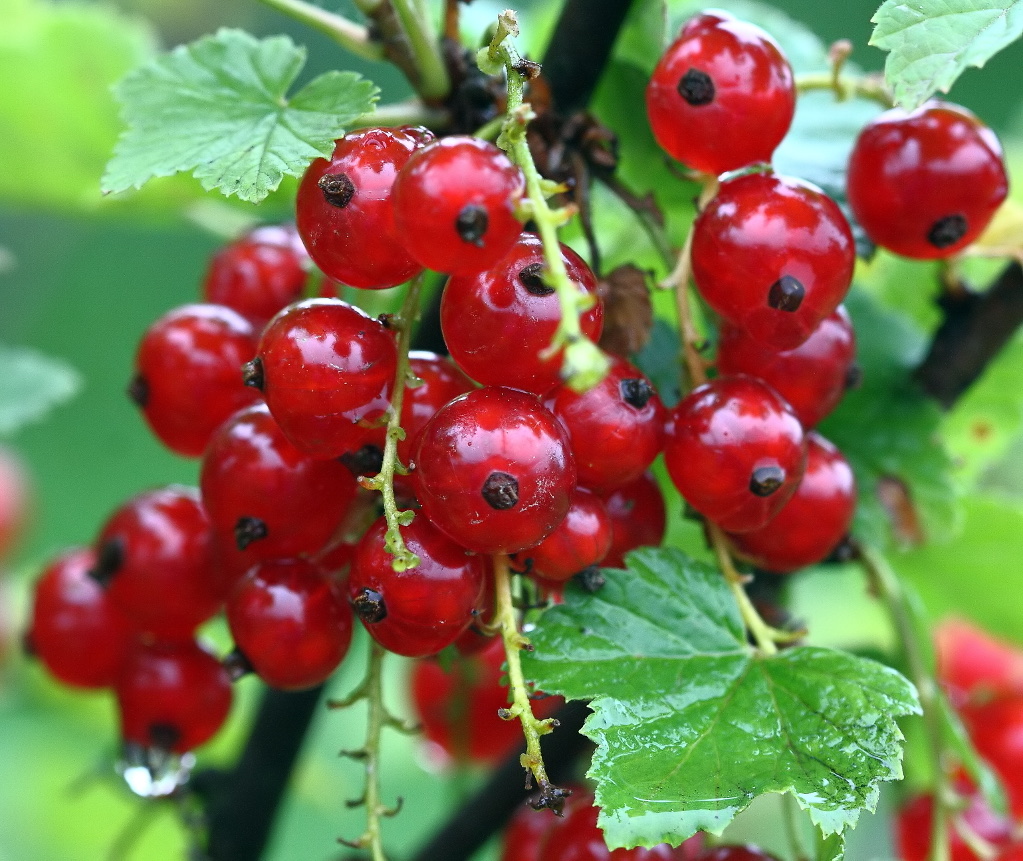
- Difficulty
- Easy
- Exhibition
- Sun or partial shade
- Watering
- Moist in summer, mulch essential
- Floor
- Moist, deep, humus-rich; tolerates clay
- Spacing
- 1.2 to 1.5 m between shrubs
- Harvest
- First strings from the 2nd year, full production after 4 years
Calendar · Belgian climate
When to sow, plant and harvest
| Activity | Jan | Feb | Mar | Apr | May | Jun | Jul | Aug | Sep | Oct | Nov | Dec |
|---|---|---|---|---|---|---|---|---|---|---|---|---|
| Plantation | yes | yes | yes | yes | yes | yes | ||||||
| Harvest | yes | yes |
Step by step
1Choosing
The currant bush comes in red varieties, such as Jonkheer van Tets, early, or Rovada, late with long strings, and in sweeter white varieties such as Blanka or Versaillaise blanche. All are self-fertile; planting two of different ripening times spreads the harvest over six weeks. Prefer a two-year-old plant, well branched, with at least three main branches. The grafted standard form makes picking easier.
2Planting
Plant from October to March, outside frosty spells, in a wide hole dressed with compost. The redcurrant tolerates partial shade, which lets you set it at the foot of an east- or north-west-facing wall. Space the shrubs 1.2 to 1.5 m apart, bury the crown slightly to encourage new shoots from the base, and cut the branches back by a third. Mulch generously: its shallow roots quickly suffer from drought and hoeing.
3Caring
Winter pruning keeps the shrub open and productive: remove branches over four years old, crossing shoots and prostrate growth, to keep eight to ten main branches of varying ages. The fruit forms on two- and three-year-old wood. Water in dry weather in June, top up the mulch and add compost in spring. Avoid nitrogen fertilisers, which encourage aphids.
4Harvesting
Wait until the whole string is coloured and glossy, and the berries still firm: picked too early, they stay very acid. Detach the whole string by pinching its base, without stripping berries on the plant. A mature bush gives three to five kilos. Harvest in the morning by preference, in dry weather, and protect the crop from blackbirds with a net as soon as the fruit reddens.
5Storing
On the string, the currant lasts three to four days in a cool place. Strip with a fork for cooking. Its richness in pectin makes it the queen of jellies, which set without any addition. Freeze the stripped berries on a tray: they will serve all year for tarts, game sauces or a tangy coulis. The juice, pasteurised in bottles, keeps for several months.
Further reading
Planting and caring for plants properly
How to plant properly
Choosing the form: bush or standard
The currant is sold as a bush, on its own roots, or grafted on a stem of Ribes aureum at 80 or 100 cm high. The bush lives longer and renews itself from the base; the standard form frees the ground, keeps the strings clean and can be picked without bending, but it needs a permanent stake and rarely lives more than fifteen years. For a small garden or the edge of a vegetable plot, alternate the two. Vertical cordon varieties, with one or two stems trained on a wire, give longer strings at only 50 cm spacing. Always buy a two-year-old plant, with three or four well-spaced branches.
Finding the right place
The redcurrant fears dry heat more than shade: in our gardens, the partial shade of an east-facing wall or a north-west hedge suits it perfectly, provided it gets four hours of sun. Avoid frost pockets where fog lingers in April, the flowering period, and windswept spots that dry out the shallow roots. Moist loamy soil, even clay, is ideal; sandy soil will need a thick mulch and consistent watering. Allow access from two sides for picking and laying a net.
Preparing the hole and the soil
A month before planting, carefully weed out bindweed and couch grass, which would otherwise smother the shallow roots. Dig a hole 50 cm each way, a little more in compact clay, breaking up the bottom with a garden fork. Mix two or three spadefuls of mature compost and a handful of bonemeal or hoof and horn into the excavated soil. On heavy ground, work coarse sand or fine gravel into the bottom, without creating a sealed basin. Let the soil settle for a week before planting.
Planting bare-rooted
Bare-root planting, from October to March outside frosty spells, remains the best: cheaper plants, more vigorous establishment. Trim damaged roots, dip them in a slurry of soil and compost, then set the plant with the crown buried 5 cm for a bush, which multiplies shoots from the base. For a standard, keep the crown at soil level and drive the stake in before the shrub. Fill in, firm at the base, water with ten litres even if it is raining, and cut each branch back to a third to form a low, sturdy framework.
In a pot or container
The redcurrant does well in a container on an east- or west-facing terrace, in a container of at least 40 litres, with holes, filled with potting compost mixed half and half with garden soil and compost. A standard form is the most elegant in a pot and takes up little room. The sensitive point is watering: the growing medium must never dry out in June, nor become waterlogged in winter. Mulch the surface, top-dress with compost each spring and repot every three years, trimming the root ball. Allow two kilos of fruit per mature container.
Beginner's mistakes
The first mistake is planting in full sun against a south-facing wall: the strings scorch and the shrub exhausts itself. The second is hoeing: the roots run 10 cm below the surface and every stroke of the hoe injures them; mulch instead. You also see shrubs planted too close, at 80 cm, which become impossible to pick and encourage powdery mildew. Finally, do not skip the planting prune: a plant left intact fruits sooner but builds a bush bare in the centre, which will need severe renovation three years later.
Look after it properly
Watering in the first years
A one- or two-year-old redcurrant still has a limited root system: water every week in dry weather from April to July, ten litres at the base, poured slowly. The critical period runs from flowering to the swelling of the berries, in May and June: a lack of water then gives short strings and fruit that drops. After the harvest, the shrub tolerates drought but is preparing next year's buds; a watering in August during a heatwave is not wasted. Once mature, a thick mulch alone is enough in most Belgian summers.
Mulching and feeding
Mulching is the central task: a layer of 8 to 10 cm of wood chippings, dried grass clippings or dead leaves, renewed each spring, keeps the soil cool and avoids any hoeing. Under the mulch, spread in March two or three spadefuls of mature compost and a handful of sieved wood ash, rich in potash, which the redcurrant appreciates. Avoid fresh manure and fast-acting nitrogen fertilisers, which give soft shoots overrun with aphids. On poor soil, a handful of sulphate of potash in February corrects potash deficiencies.
Pruning: formation, then fruiting
For the first three years, form a bush of eight to ten upright main branches by cutting the leaders back by half each winter to an outward-facing bud. After that, fruiting pruning is done each winter, between December and February: remove at the base one or two branches over four years old, recognisable by their dark, scaly bark, take out prostrate wood and shoots in the centre, then shorten the current year's side shoots to two or three buds to create fruit buds. On cordons, pinch the side shoots to five leaves in June.
Preventing diseases and pests
The currant blister aphid, which puckers the leaves red, is fought by spraying soft soap from April and avoiding nitrogen; the ladybirds then take over. The gooseberry sawfly, a green false caterpillar spotted with black, can strip a bush in a week in May: inspect the heart of the shrub and crush the larvae. Against powdery mildew, open up by pruning and spray milk diluted to 10 % or a horsetail decoction. The net against blackbirds, laid over a frame as soon as the strings blush, remains the most worthwhile protection of all.
Through the season
In February, prune and add compost and ash. In April, watch for the first aphids under the young leaves and lay a fleece if a frost threatens the flowering. In May, water if the month is dry, that is the most important. In June, stretch the net, pick the red strings from the end of the month, and harvest the whites in July. After the harvest, remove the net, top up the mulch and leave the shrub alone. In autumn, gather fallen leaves if rust spots have appeared. A notebook of dates helps a lot from one year to the next.
Harvesting and storing
Beyond the basics, know that the currant gains from staying a week longer on the bush after full colouring: the sugar rises and the acidity softens, especially for the white varieties. Pick string by string with the stalk and lay them in shallow punnets so as not to crush those underneath. For jelly, mix in a third of slightly less ripe strings, richer in pectin. Strings washed then dried on a cloth freeze whole on a tray, which lets you strip them frozen, without damaging them.
Obtaining seeds or seedlings
Seeds and seedlings: where to find them
A selection of reputable seed suppliers that deliver to your country, listed in order of proximity. Evadya does not receive any commission: these are suppliers we recommend for their reliability.
Semailles
For Belgian artisan seed producer, organic and reproducible seeds, over 250 regional varieties, a planting calendar tailored to the Belgian climate.
Against Small organisation: limited range of hybrid varieties and possible stock shortages during peak season.
Search for ‘redcurrant’ on SemaillesFerme de Sainte Marthe
For A long-established organic seed supplier, offering seeds and young plants, heirloom varieties, and nutrition and recipe guides.
Against Dispatched from the Loire: postage charges to Belgium and Switzerland; plants are fragile in transit.
Search for ‘redcurrant’ on Ferme de Sainte MartheVreeken’s Zaden
For A very wide range of Dutch products, competitive prices, and numerous varieties suited to the Benelux climate.
Against Website in Dutch only; limited selection of organic produce.
Search for ‘redcurrant’ on Vreeken’s ZadenFrom the vegetable patch to the plate
And then we savour it
What it offers
The redcurrant is very rich in vitamin C, fibre and pectin, with little sugar.
In the kitchen, it’s simple
A few stripped strings on a fromage frais tart or in a fruit salad bring the tangy contrast that is so often missing.
Living well
The red strings hanging in July are the cheeriest sight in the garden, to be admired before picking.
Also worth a look