herb · Amaryllidacées
ChivesAllium schoenoprasum
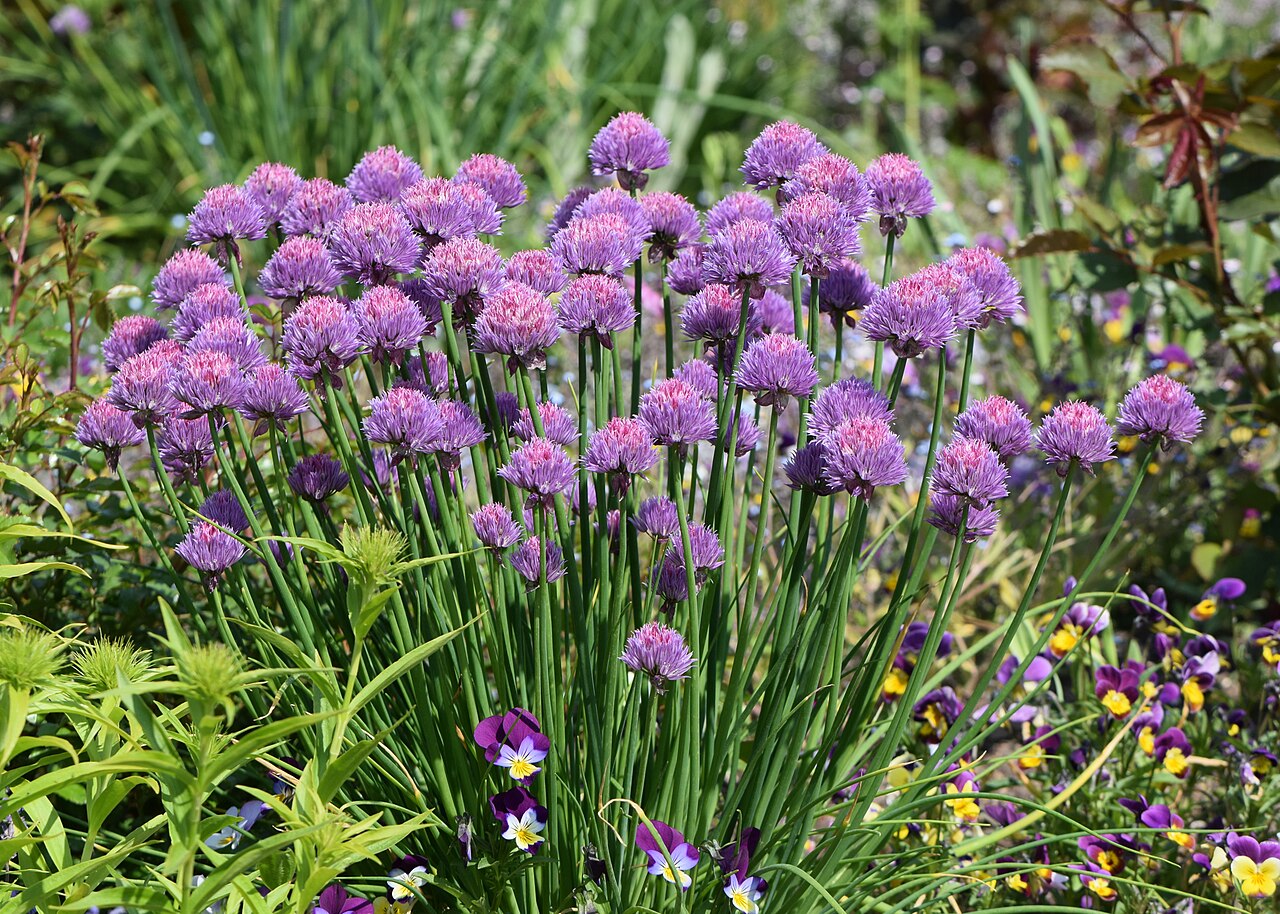
Chives are the herb of every garden, even without a garden: a perennial clump in a pot is enough for years. Their hollow stems with a mild onion taste are cut from March to November, and their edible pink pompoms feed the bees in May. Hardy, they shrug off our winters.
- Difficulty
- Easy
- Exhibition
- Sun or partial shade
- Watering
- Regular, especially in a pot; the clump yellows and toughens if it is thirsty.
- Floor
- Any moist, rich, well-drained soil; in a pot, compost enriched with garden compost.
- Spacing
- 20 to 25 cm between clumps.
- Harvest
- 80 to 100 days from sowing, first cut the spring after planting.
Calendar · Belgian climate
When to sow, plant and harvest
| Activity | Jan | Feb | Mar | Apr | May | Jun | Jul | Aug | Sep | Oct | Nov | Dec |
|---|---|---|---|---|---|---|---|---|---|---|---|---|
| Sowing under cover | yes | yes | ||||||||||
| Sowing in open ground | yes | yes | yes | yes | yes | |||||||
| Plantation | yes | yes | yes | yes | yes | |||||||
| Harvest | yes | yes | yes | yes | yes | yes | yes | yes | yes |
Step by step
1Sowing
Sow from March to May or in August-September, in place or in pots, in stations of about ten seeds, half a centimetre deep, in fine, moist soil. Germination takes two to three weeks. A February sowing indoors, in a pot, gives clumps ready to go out in May. Do not separate the seedlings: chives live as a clump.
2Planting
Plant sown or bought clumps, or pieces from a division, from March to May or in September-October, every 20 to 25 cm, in soil enriched with compost, the crown at soil level. Water copiously. In a pot, choose at least 20 cm across with good drainage. Along the edge of a bed, they keep some pests away from carrots and roses.
3Caring
Water regularly in summer, especially in a pot, and mulch in open ground. Cut the whole clump back to 3 cm above the ground two or three times a season to renew tender foliage, and remove faded flowers if you are not saving seed. Add compost in spring. Divide every three years in March or October so the clump does not exhaust itself in the centre.
4Harvesting
Cut with scissors, 2 or 3 cm above the ground, the stems you need, preferably from the outer half of the clump, as soon as it reaches 15 cm in spring. Never cut just the tips: the whole stem then regrows badly. The pink flowers of May-June, picked fresh, are scattered over salads. The harvest runs from March until the November frosts.
5Storing
Fresh, chives last a week in the fridge in a bag or a damp cloth. Snipped and frozen flat, or as ice cubes, they keep their taste for several months and can be sprinkled straight onto the dish. Dried, they lose almost everything, so best not bother. A pot brought indoors in winter, after a few weeks of cold, gives fresh stems in February.
Further reading
Planting and caring for plants properly
How to plant properly
Choosing the spot
Chives are perennial and hardy: they settle in for years in a sunny or partly shaded corner, in moist, rich soil. The edge of a bed, where they do not get in the way of digging, the foot of roses or strawberries, from which they keep certain pests away, or a pot on the kitchen windowsill suit them perfectly. Only avoid soils that stay drowned in winter, where the bulbs rot, and dry, scorching corners, which yellow and toughen the stems from July. Two or three clumps are enough for a family.
Preparing the soil
Loosen to 20 cm and work in two to three kilos of mature compost per square metre, as chives appreciate nourishing soil to regrow after each cut. On heavy clay, add a spadeful of coarse sand for drainage, or plant on a slight hump. Crumble the surface finely if you are sowing, as the seeds are small. In a pot, prepare a mix of two thirds potting compost and one third garden compost, over 3 cm of clay pebbles, in a container at least 20 cm across and deep, with drainage holes.
Sowing at the right time
Sow from March to May in open ground, or in August-September for clumps ready the following spring. Make stations of about ten seeds every 20 cm, 5 mm deep, in fine soil kept moist; germination takes two to three weeks at 15 °C. Never separate the seedlings, as chives live in a tight clump. A February sowing indoors, in a 12 cm pot at 18 °C, gives a clump to put out in May. The seeds quickly lose their viability: use this year's or last year's at most.
Choosing the plant or the division
Quickest is a division taken in March or October from a neighbour's clump: about ten bulblets with their roots, separated by hand from the root ball, are enough to make a new clump productive by summer. Shop plants should be chosen upright, bright green, without dry tips. A supermarket pot, too dense, can be divided into four after soaking and repotted straight away. Common chives suit everyone; Staro gives thick stems for the kitchen; Chinese chives, with flat leaves and a garlic taste, deserve a pot of their own.
Planting as a clump
Plant clumps, divisions or plants from March to May or in September-October, every 20 to 25 cm, in a hole twice the size of the root ball. Set the crown at soil level, the bulblets just covered, firm and water copiously, a litre per clump. Cut the stems back to 5 cm after a division to limit evaporation while the roots take hold. A light mulch of sieved compost around the clump feeds it and keeps the soil cool. Divisions planted in autumn establish best and give a first abundant cut from March.
In a pot on the window
Chives are the pot herb par excellence: a 20 cm pot, rich compost, an east- or west-facing windowsill, and they produce ten months a year. Water as soon as the surface dries, every two days in summer, emptying the saucer, and give a liquid organic feed every three weeks from April to September. Divide and repot every year in March, as the clump quickly exhausts a small volume. The pot spends winter outside without concern; brought in during January after a few weeks of frost, it starts again within a fortnight.
Beginner's mistakes
Separating the seedlings one by one at transplanting, like lettuces, gives isolated stems that languish: chives are handled by the clump. Cutting only the tips of the stems leaves stubble that dries and looks ugly; you cut 2 cm above the ground. Leaving a clump in the same pot for three years without dividing makes it yellow in the centre. Forgetting to water in July toughens the stems. Finally, bringing the pot indoors from October stops it getting the cold it needs to renew itself: let it freeze for a few weeks before forcing it in January.
Look after it properly
Watering just right
In open ground, chives make do with our rain in spring and autumn, but demand water in summer: five litres per clump once or twice a week without rain, at the base, preferably in the evening. A thirsty clump yellows from the tips of the stems, toughens and flowers prematurely. In a pot, water as soon as the surface of the compost dries, almost every day in July-August, never leaving the saucer full, as the bulblets fear suffocation. After each complete cut, a copious watering relaunches regrowth within days.
Mulching and feeding
In spring, scratch a handful of mature compost in around each clump and mulch with 3 cm of dried grass clippings or shredded leaves, keeping the heart clear. Chives regrow after each cut thanks to nitrogen: nettle liquid diluted to 10 % in April, June and August keeps up the pace. In a pot, replace this with a liquid organic feed every three weeks. A pale, thin clump lacks food; a clump that flops has too much and lacks light. Stop all feeding in September to let the plant go into rest.
Cutting, flowering, dividing
Cut with scissors 2 or 3 cm above the ground, by the handful, starting from the outside of the clump, as soon as the stems are 15 cm long. Two or three times a season, cut the whole clump back, water and feed: it starts again within ten days with fine, tender stems, especially if you do it just after flowering. The pink pompoms of May-June are edible and feed the bees; leave them, but cut them off once faded to avoid invasive self-seeding. Every three years, in March or October, dig up the clump, divide it into four by hand and replant the vigorous pieces in fresh soil.
Preventing diseases and pests
Rust is the only common disease: orange pustules appear on the stems in a hot, humid summer. Then cut the whole clump back to the ground, put the waste in the bin and not the compost, water, feed; the regrowth is healthy. Divide and space out clumps that are too dense, which dry badly. Black aphids are rare and go with a jet of water. Onion fly can reach a weakened clump; remove the soft bulblets and replant elsewhere. Yellowing in the centre signals an ageing clump or exhausted soil, and is fixed by division.
Through the season
March, removal of dry stems, division if needed, compost and liquid feed, first cuts. April-May, full production, flowering, picking the pompoms. June, complete cut-back after flowering, watering and feeding. July-August, diligent watering, second cut-back if the stems toughen. September, last abundant cuts, autumn sowing or planting. October-November, the clump yellows and goes into rest; leave the dry foliage in place, it protects the bulblets. December, nothing to do, or bring in a pot after a few frosts. January-February, forcing a pot on the window for fresh stems before spring.
Harvesting and extending the season
Chives are cut from March until the November frosts, with a lull in high summer if they lack water. To enjoy them in winter, lift a clump with its root ball in November, let it freeze outside for three or four weeks in a pot, then bring it in during January onto a bright windowsill, at 15 to 18 °C: its dormancy broken by the cold, it regrows within a fortnight. A cold frame or a cloche placed in February over a clump in the ground brings the first cut forward by three weeks. A forced clump must then rest outside for the whole growing season.
Obtaining seeds or seedlings
Seeds and seedlings: where to find them
A selection of reputable seed suppliers that deliver to your country, listed in order of proximity. Evadya does not receive any commission: these are suppliers we recommend for their reliability.
Semailles
For Belgian artisan seed producer, organic and reproducible seeds, over 250 regional varieties, a planting calendar tailored to the Belgian climate.
Against Small organisation: limited range of hybrid varieties and possible stock shortages during peak season.
Search for ‘chives’ on SemaillesKokopelli
For Europe’s largest collection of heirloom, organic and open-pollinated varieties; comprehensive growing guides.
Against No hybrids or seedlings; delivery times can sometimes be long during peak season; prices are slightly higher.
View the shopFerme de Sainte Marthe
For A long-established organic seed supplier, offering seeds and young plants, heirloom varieties, and nutrition and recipe guides.
Against Dispatched from the Loire: postage charges to Belgium and Switzerland; plants are fragile in transit.
Search for ‘chives’ on Ferme de Sainte MartheGraines Baumaux
For A vast selection (over 500 tomato varieties), with high-yielding F1 hybrids and heirloom varieties side by side, and plants available in season.
Against Not much organic produce; an old site; catalogue entries rather than growing guides.
Search for ‘chives’ on Graines BaumauxVreeken’s Zaden
For A very wide range of Dutch products, competitive prices, and numerous varieties suited to the Benelux climate.
Against Website in Dutch only; limited selection of organic produce.
Search for ‘chives’ on Vreeken’s ZadenDe Bolster
For Dutch organic seed producer, seeds suitable for propagation, a good selection for cool climates.
Against A shorter catalogue; website in Dutch.
Search for ‘chives’ on De BolsterZollinger Bio
For Swiss organic seeds, varieties suited to high altitudes and microclimates, and a unique phenological calendar.
Against Swiss prices and customs charges from the European Union.
Search for ‘chives’ on Zollinger BioBingenheimer Saatgut
For A leading German name in organic and biodynamic produce, offering open-pollinated varieties selected for the home gardener.
Against Website in German; delivery charges apply outside Germany.
Search for ‘chives’ on Bingenheimer SaatgutDreschflegel
For A collective of organic growers, specialising in rare and regional varieties, and the preservation of traditional farm seeds.
Against Small quantities; a catalogue that’s more activist than practical; website in German.
Search for ‘chives’ on DreschflegelFrom the vegetable patch to the plate
And then we savour it
What it offers
A herb rich in vitamin K and vitamin C, with sulphur compounds close to those of the onion.
In the kitchen, it’s simple
Snipped over scrambled eggs, in a herby fromage frais in the style of Brussels plattekaas, or over warm potatoes in a salad.
Living well
The snip of scissors in the clump of chives is one of the first sounds of spring in the garden.
Also worth a look