herb · Lamiacées
BasilOcimum basilicum
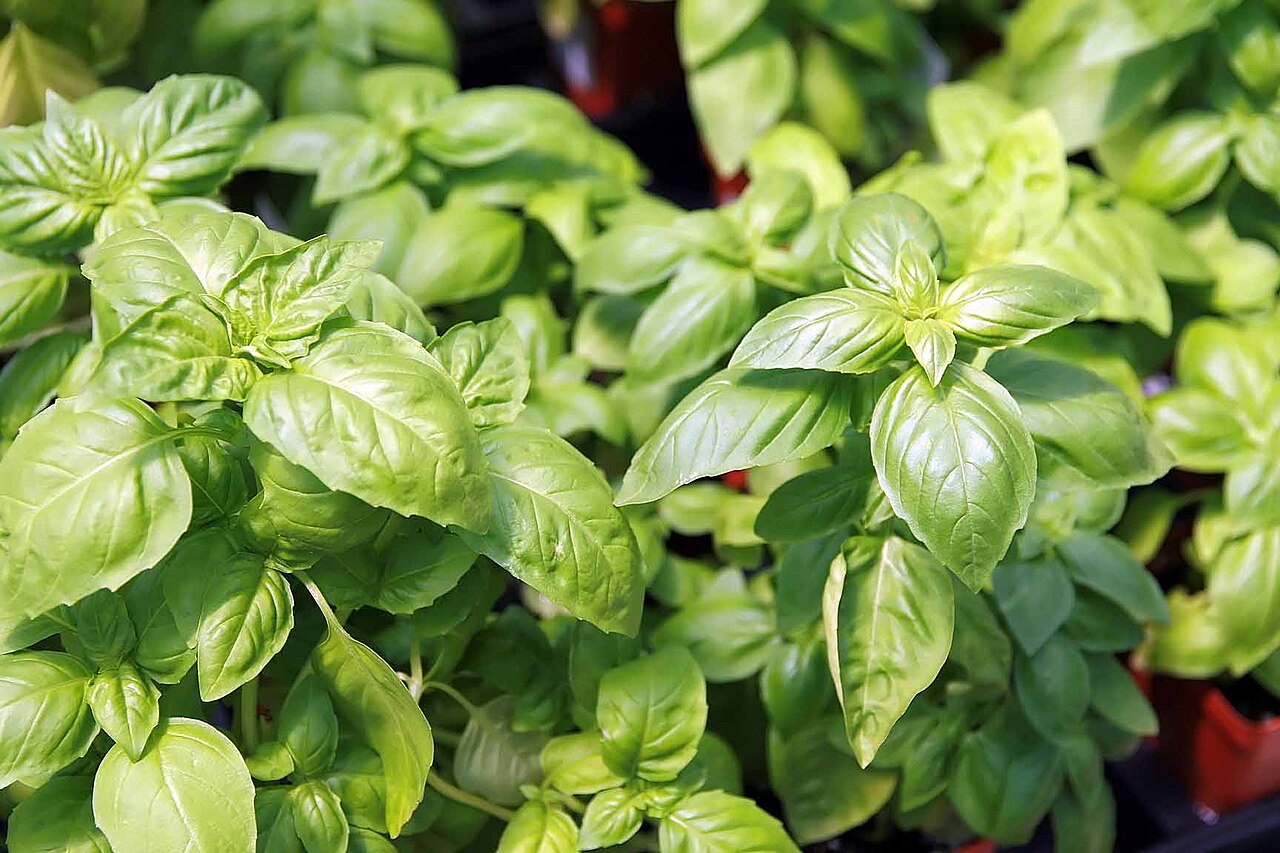
Basil brings the scent of summer to the kitchen, but it hates the cold: at our latitudes, it succeeds mainly in a pot in the warm, on a windowsill or a sunny terrace. Sown in warmth in April, it gives leaves from June until the first cold spells, for tomatoes and pesto.
- Difficulty
- Intermediate
- Exhibition
- Full sun, warm and sheltered
- Watering
- Regular, in the morning, without wetting the foliage; never a full saucer.
- Floor
- Rich, free-draining potting compost in a pot; in open ground, light, warm soil enriched with compost.
- Spacing
- 20 to 25 cm between plants, or one plant per 15 cm pot.
- Harvest
- 60 to 80 days.
Calendar · Belgian climate
When to sow, plant and harvest
| Activity | Jan | Feb | Mar | Apr | May | Jun | Jul | Aug | Sep | Oct | Nov | Dec |
|---|---|---|---|---|---|---|---|---|---|---|---|---|
| Sowing under cover | yes | yes | yes | |||||||||
| Plantation | yes | yes | ||||||||||
| Harvest | yes | yes | yes | yes | yes |
Step by step
1Sowing
Sow from March to May indoors, at 20 to 25 °C, in a seed tray or pots, on fine compost. Barely cover, as the seed needs light and warmth to germinate in five to ten days. Thin or prick out in groups of two or three seedlings into pots. Place in full light, on a south-facing windowsill, so the plants do not become drawn.
2Planting out
After mid-May, harden the plants off for a week outside by day, then set them in a greenhouse, a tunnel, a pot or a well-placed window box, 20 cm apart, in rich compost. In open ground, choose the warmest spot, against a south-facing wall, at the foot of the tomatoes. Water at the base, without wetting the leaves.
3Caring
Water in the morning, regularly but not excessively, letting the compost dry slightly on the surface between waterings. Pinch out the tips of the stems as soon as they carry three pairs of leaves: the plant branches and produces more. Always remove the flower buds, which make the leaves tougher. A little liquid organic feed each month supports a potted plant.
4Harvesting
Pick as and when you need it, pinching the tips of the stems above a pair of leaves rather than leaf by leaf: the plant comes back stronger. Harvest in the morning, when the essential oils are most concentrated, and preferably before flowering. A big harvest in September, before the cold nights, lets you stock up on pesto.
5Storing
Fresh basil keeps two days in a glass of water at room temperature, never in the fridge, which blackens it. Best is to process it straight away: as pesto, as ice cubes of chopped leaves in olive oil, or as a flavoured oil. Drying makes it lose almost all its scent. A plant brought in during September onto a warm window lives on for a few more weeks.
Further reading
Planting and caring for plants properly
How to plant properly
Choosing the spot
Basil is a plant of warmth: below 15 °C it stalls, below 10 °C it blackens. Here, it really only succeeds in the warmest places, namely a greenhouse, a tunnel, a south-facing windowsill, a terrace against a light-coloured wall that gives back heat in the evening, or the foot of the tomatoes in open ground in clement years. It needs at least six hours of direct sun, and shelter from wind, which tears its tender leaves. A window box on the kitchen windowsill often produces more than a whole bed at the bottom of the vegetable garden.
Preparing the growing medium
In a pot, mix two thirds good-quality potting compost with one third sieved garden compost, with a handful of coarse sand or perlite for drainage, and a layer of clay pebbles at the bottom. Basil fears drowned roots as much as drought: the mix must stay loose and drink quickly. In open ground, choose light, warmed soil enriched with two kilos of compost per square metre, on a slight mound in our clay soils. Avoid fresh manure, which attracts aphids, and cheap multi-purpose compost, which compacts and suffocates the roots.
Sowing at the right time
Sow between 15 March and 15 May indoors, at 20 to 25 °C, in a seed tray or directly in 10 cm pots filled with moistened fine compost. Spread five or six seeds per pot, press them onto the surface and cover with a millimetre of vermiculite or sieved compost. Cap with a plastic bag until germination, in five to ten days, then remove it and place in the brightest light possible, otherwise the seedlings stretch and flop. An April sowing is the best balanced: the plants are ready to go out at the end of May without having languished on the window.
Choosing the plant
The pots of basil sold in supermarkets contain dozens of crowded seedlings, forced under glass and doomed to fade within a week on the table. To save them, remove from the pot, gently separate the root ball into three or four bunches under a trickle of lukewarm water, and repot each in a 12 cm pot of fresh compost. At the garden centre, prefer a stocky, dark green plant, without flowers or yellow leaves, in a 9 cm pot. The varieties Genovese or Grand vert suit pesto, the dwarf Fin vert stays compact in a pot, and Thai and Lemon basil cope a little better with our cool summers.
Pricking out and planting
When the seedlings carry two true leaves, prick them out in groups of three into 8 cm pots, burying them up to the seed leaves to strengthen the stem. Harden off for a week outside by day from mid-May, then plant after the Ice Saints, when the nights stay above 10 °C, every 20 to 25 cm in open ground or as a clump of three in a 15 to 20 cm pot. Water at the base with water warmed in the sun. In a greenhouse, plant from early May between the tomatoes, 30 cm from their base. Put a cloche over them for the first few nights if the weather turns cooler.
In a pot or window box
The pot is the safest way to grow basil in Belgium. Choose a terracotta or light-coloured plastic container, 15 cm across for one clump, a 40 cm window box for three, with drainage holes and a saucer you will always empty. Place it facing south, against a wall, and raise it on blocks to keep slugs away. The pot lets you follow the warmth: on the terrace by day, brought into the conservatory or kitchen on cool nights in June and from September. Refresh the surface of the compost every month and feed every fortnight.
Beginner's mistakes
Putting basil out in early May, on the first fine day, and finding it blackened after a night at 6 °C: that is mistake number one. Next comes evening watering, which leaves the foliage damp and cold all night, then the full saucer that drowns the roots. Many also let the plant flower, which toughens the leaves and stops production. Finally, keeping the supermarket pot as it is, without dividing it, leads to losing the plant within ten days. Basil forgives many things, but not cold damp or neglecting to pinch.
Look after it properly
Watering in the morning, without excess
Water in the morning, with lukewarm water, at the base of the plant and never on the foliage, letting the surface of the compost dry between waterings. In summer, a 15 cm pot in full sun needs water every morning; in overcast weather, every second or third day is enough. The finger test is reliable: moist at 2 cm, you wait. A basil that wilts at midday and perks up in the evening is hot, not thirsty. On the other hand, limp leaves in the morning and sodden compost announce root rot: empty the saucer, let it dry, repot if necessary.
Feeding regularly
In a pot, the compost's reserves run out in six weeks. Give, every fortnight from June to September, a liquid organic feed diluted to half the stated dose, or nettle liquid diluted to 5 %, watering onto compost that is already moist so as not to burn the roots. A top-dressing of a handful of sieved compost each month rounds this off well. In open ground, a fine mulch of dried grass clippings keeps in warmth and moisture, provided you lay it on soil that has already warmed up, in June, and keep it 3 cm from the stems. Too much nitrogen gives large, bland leaves: moderation is the rule.
Pinching out to branch
The step that changes everything is pinching. As soon as the plant carries three pairs of leaves, cut with fingernails or scissors the tip of the stem just above the second pair: two new stems will grow from the axils. Repeat on each stem every fortnight. A plant managed this way forms a dense 30 cm ball instead of a single bare stem. Remove every flower bud in the same way as soon as it forms, cutting below the first pair of leaves; flowering would tell the plant its season is over, and its leaves would turn leathery and bitter.
Preventing diseases and pests
Slugs and snails devour a young basil in one night: raised pots, evening collection, ash or eggshells around plants in the ground. Aphids lodge under the young leaves; a jet of water in the morning then soft soap at 5 % sprayed under the foliage deals with them. Basil downy mildew, a grey felting under yellowed leaves, strikes in cool, damp weather: space out, ventilate, water at the base in the morning, remove affected leaves, and bring the pot in to the dry. Damping off is prevented with fresh compost and watering from below. No synthetic treatment is ever justified on a herb eaten raw.
Through the season
April, sowing in warmth and dividing shop-bought pots. Mid-May, gradual hardening off, then final move outside after 20 May. June, first pinching, feed every fortnight, cloche on cool nights. July-August, full production, regular pinching, daily morning watering in pots, watching for aphids. Late August, big harvest for pesto while the leaves are still fragrant. September, bringing the pot in as soon as the nights drop below 10 °C, onto the brightest window. October, last pickings; the plant declines as the light fades, which is normal.
Harvesting and overwintering
Harvest in the morning, pinching the stem tips rather than stripping leaves, which stimulates regrowth. Never take more than a third of the plant at once. To get through winter, annual basil needs more light than our windows offer in December: it survives until November on a south-facing sill, then becomes leggy and fades. The most reliable solution is to take 10 cm tip cuttings in September in a glass of water, which root in a fortnight, then grow them on in small pots under a grow lamp or a very bright window, at 18 °C, with moderate watering, for a fresh start in March.
Obtaining seeds or seedlings
Seeds and seedlings: where to find them
A selection of reputable seed suppliers that deliver to your country, listed in order of proximity. Evadya does not receive any commission: these are suppliers we recommend for their reliability.
Semailles
For Belgian artisan seed producer, organic and reproducible seeds, over 250 regional varieties, a planting calendar tailored to the Belgian climate.
Against Small organisation: limited range of hybrid varieties and possible stock shortages during peak season.
Search for ‘basil’ on SemaillesKokopelli
For Europe’s largest collection of heirloom, organic and open-pollinated varieties; comprehensive growing guides.
Against No hybrids or seedlings; delivery times can sometimes be long during peak season; prices are slightly higher.
View the shopFerme de Sainte Marthe
For A long-established organic seed supplier, offering seeds and young plants, heirloom varieties, and nutrition and recipe guides.
Against Dispatched from the Loire: postage charges to Belgium and Switzerland; plants are fragile in transit.
Search for ‘basil’ on Ferme de Sainte MartheGraines Baumaux
For A vast selection (over 500 tomato varieties), with high-yielding F1 hybrids and heirloom varieties side by side, and plants available in season.
Against Not much organic produce; an old site; catalogue entries rather than growing guides.
Search for ‘basil’ on Graines BaumauxVreeken’s Zaden
For A very wide range of Dutch products, competitive prices, and numerous varieties suited to the Benelux climate.
Against Website in Dutch only; limited selection of organic produce.
Search for ‘basil’ on Vreeken’s ZadenDe Bolster
For Dutch organic seed producer, seeds suitable for propagation, a good selection for cool climates.
Against A shorter catalogue; website in Dutch.
Search for ‘basil’ on De BolsterZollinger Bio
For Swiss organic seeds, varieties suited to high altitudes and microclimates, and a unique phenological calendar.
Against Swiss prices and customs charges from the European Union.
Search for ‘basil’ on Zollinger BioBingenheimer Saatgut
For A leading German name in organic and biodynamic produce, offering open-pollinated varieties selected for the home gardener.
Against Website in German; delivery charges apply outside Germany.
Search for ‘basil’ on Bingenheimer SaatgutDreschflegel
For A collective of organic growers, specialising in rare and regional varieties, and the preservation of traditional farm seeds.
Against Small quantities; a catalogue that’s more activist than practical; website in German.
Search for ‘basil’ on DreschflegelFrom the vegetable patch to the plate
And then we savour it
What it offers
A herb rich in vitamin K and antioxidants, whose scent comes from its essential oils.
In the kitchen, it’s simple
Garden tomatoes, mozzarella and hand-torn basil, or homemade pesto on hot pasta, with local walnuts in place of pine nuts.
Living well
Brushing your basil as you pass the window and smelling summer on your fingers is a small ritual that lifts the mood.
Also worth a look