root vegetable · Brassicacées
RadishRaphanus sativus
Ready in three to four weeks, the radish is the fastest crop in the vegetable garden and the first harvest of spring. It slips in anywhere, between two rows or in a window box, and is resown throughout the season. Crunchy, peppery in just the right measure, it whets the appetite.
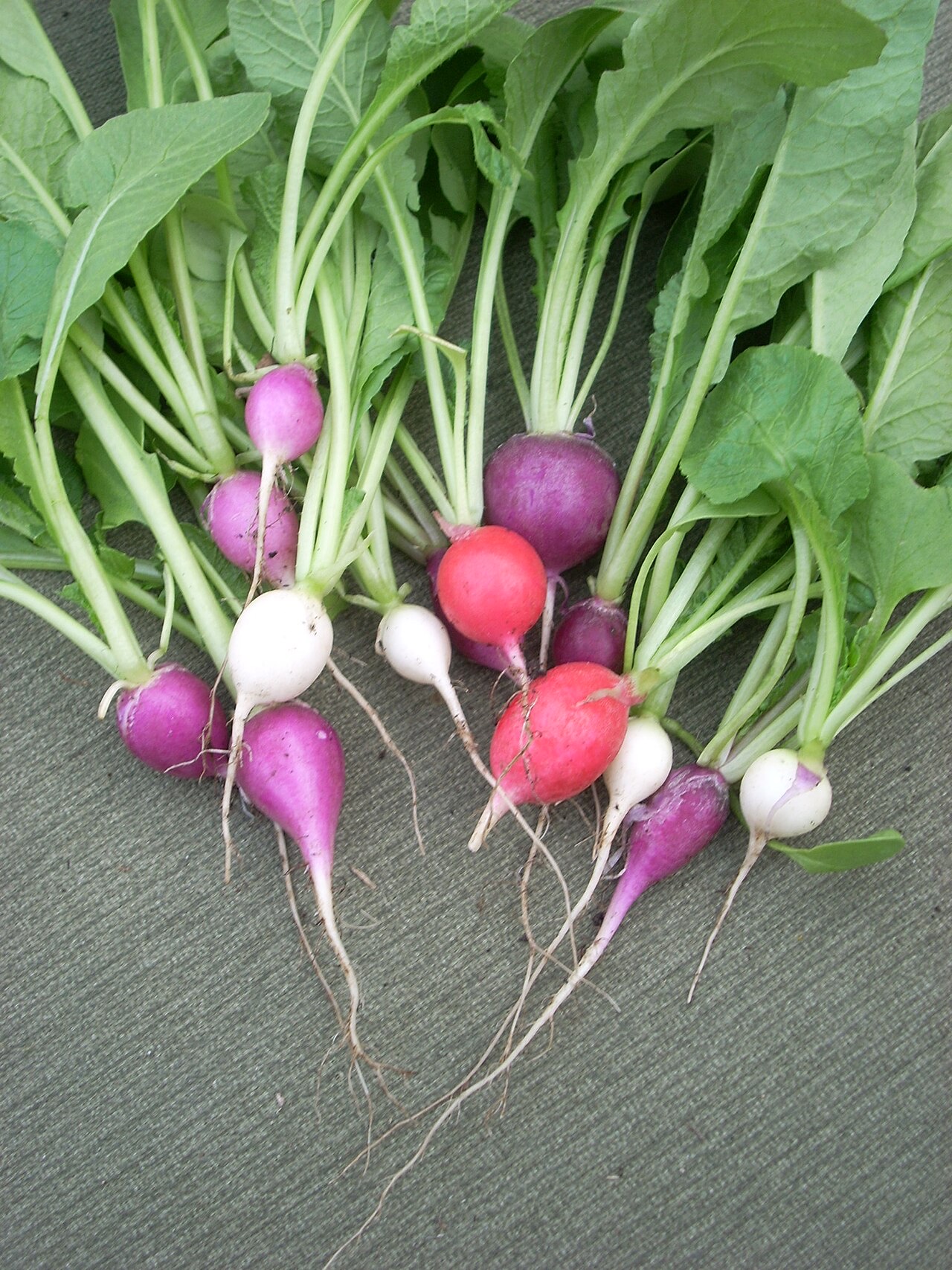
- Difficulty
- Easy
- Exhibition
- Sun in spring, partial shade in summer
- Watering
- Frequent and regular, never any drought
- Floor
- Light, moisture-retentive, loose, rich in humus
- Spacing
- 3 to 5 cm along the row, 15 cm between rows
- Harvest
- 25 to 35 days after sowing
Calendar · Belgian climate
When to sow, plant and harvest
| Activity | Jan | Feb | Mar | Apr | May | Jun | Jul | Aug | Sep | Oct | Nov | Dec |
|---|---|---|---|---|---|---|---|---|---|---|---|---|
| Sowing under cover | yes | |||||||||||
| Sowing in open ground | yes | yes | yes | yes | yes | yes | yes | |||||
| Harvest | yes | yes | yes | yes | yes | yes | yes |
Step by step
1Sowing
Sow from March to September, in small quantities every two weeks, in a finely prepared soil. Draw drills one centimetre deep and fifteen centimetres apart and drop a seed every three centimetres, or broadcast over a small bed. Cover with fine compost, firm and water. Germination takes three to five days. Sowing too thickly gives radishes that are all leaf: sow thinly or thin early.
2Planting out
The radish is not transplanted; its root becomes misshapen and its lightning growth makes the operation pointless. For a very early harvest, sow in February under a cold frame, under a tunnel or in a window box behind a window, in light compost. It also slips in as a catch crop between rows of carrots, lettuces or peas, where it is harvested before its neighbours need the room.
3Caring
Everything hinges on watering: the radish must grow fast and without interruption, otherwise it turns hot, hollow or fibrous. Water every two days in spring, every day in summer, with a fine spray. Thin to three centimetres as soon as the seedlings are up if the sowing is dense, hoe lightly and mulch finely. Insect-proof mesh from sowing protects against flea beetles, which riddle the leaves with small holes in hot, dry weather.
4Harvesting
Harvest as soon as the radishes reach the size of a large marble, usually three to four weeks after sowing in spring, a little faster in summer. Pull on the leaves while holding the soil down with the other hand. Do not wait: an overripe radish goes hollow and hard within days. Pick as you go, starting with the largest, which leaves room for the others to swell.
5Storing
The radish is eaten within two or three days. To keep it for a week, remove the tops, which draw water out of the root, and put it in the fridge in a damp cloth or a jar of water. Do not freeze it. Fresh tops make an excellent soup or pesto. Winter radishes, black or pink, keep for several months in the cellar in sand.
Further reading
Planting and caring for plants properly
How to plant properly
Choosing the spot
The radish settles in wherever there are thirty centimetres free: at the edge of a bed, between two rows of carrots or leeks, at the foot of the tomatoes in May, in a window box. In spring and autumn, give it full sun; in July and August, prefer the partial shade of a row of beans or a wall, where it stays tender. It dislikes soils that dry out quickly or form a crust. Avoid sowing it where cabbages or turnips have just grown, as it shares their pests, and make the most of its speed to slot it in ahead of slow crops.
Preparing the soil
The radish is content with ordinary soil provided it is loose to ten or fifteen centimetres and fine on the surface. Scratch over the bed, remove stones and break the clods until the surface is fine, with no manure or young compost, which make the roots hollow and attract maggots. Soil manured for the previous crop is more than enough. In clay soil, mix a little sand or potting compost into the surface so the young roots do not hit a barrier. Rake just before sowing so the soil is fresh and crust-free, as the small seeds cannot push through a crust.
Sowing at the right time
Spring radishes are sown from March under fleece, then in the open from April to mid-June and again from mid-August to the end of September: in July, they turn hot and hollow. Winter radishes, black or pink, are sown just once between 15 July and 15 August. Sow little and often, a metre of row every ten to fifteen days, in a one-centimetre drill, one seed every three centimetres, or broadcast very thinly over a small bed. Cover with half a centimetre of fine soil and firm. Germination takes three to six days depending on the temperature. Note the date so you do not forget the next row.
Getting an early start
The radish is never transplanted, but it is happy to be hurried along. From late February, sow in a cold frame, under a low tunnel or under a cloche, in soil warmed by fleece laid a week beforehand, with a short, fast variety such as 18 jours or Cherry Belle. Ventilate as soon as the sun warms up, otherwise the seedlings become leggy. A sowing behind a window in a fifteen-centimetre-deep window box works too. Then choose varieties according to the season: round red ones in spring, half-long white-tipped ones in summer, the large round black ones for winter.
In pots or containers
The radish is the king of balcony crops, ready in a month. A window box fifteen centimetres deep is enough for round varieties, twenty for half-long ones and thirty for winter radishes. Fill with ordinary potting compost mixed with a third of soil or sand, without fertiliser, sow in rows ten centimetres apart and thin to three centimetres. Put the box in the sun in spring, in afternoon shade in summer, and water every day or every other day: that is the only condition for success. A sixty-centimetre box, sown in two halves a fortnight apart, gives two bunches.
Beginner's mistakes
Sowing the whole packet at once and harvesting fifty radishes in the same week. Sowing thickly and not thinning, with superb leaves and no roots to speak of. Forgetting to water for three days: the radish turns hot, hollow or bolts. Sowing in the middle of a heatwave in a scorching corner. Digging in fresh compost just beforehand. Letting flea beetles riddle the leaves without watering or covering. Waiting until the radishes are as big as walnuts: by then they are already hollow. Harvesting a whole row instead of picking the largest as you go, leaving room for the others.
Look after it properly
Watering properly
A successful radish has grown fast without a single day of thirst. Water with a fine spray from sowing, then every two days in spring and every day in summer, morning or evening, aiming for soil that is always moist in the top ten centimetres. Three litres per metre of row is enough if it is regular. A radish short of water hardens, goes hollow, turns hot and flowers; a sudden excess after drought splits it. Water the foliage too at the end of the day in hot, dry weather, as this discourages flea beetles. In containers, check every day with a finger pushed into the compost.
Mulching and feeding
The radish needs no fertiliser: it lives on the soil's reserves for its four weeks, and excess nitrogen gives leaves at the expense of roots. A very fine mulch, dried grass clippings or hemp mulch one or two centimetres deep, spread as soon as the seedlings have two leaves, keeps the surface moist, prevents capping and spaces out watering. Do not lay a thick mulch; slugs hide in it and the seedlings lack light. For winter radishes, which take longer to come, a five-centimetre mulch in September keeps the coolness needed for tender roots.
Thinning
Thin as soon as the seedlings are up, at the two-small-leaf stage, leaving one plant every three centimetres for round varieties, five for half-long ones and ten for winter radishes. It is a two-minute job that decides everything: too crowded, the radishes form no root. Pinch out the surplus seedlings between two fingers rather than pulling them, so as not to disturb the neighbours, then water. Hoe lightly once if a crust forms, but do not earth up or work the soil deeply. Remove plants that bolt; they will give nothing.
Preventing diseases and pests
Flea beetles, small black jumping beetles, riddle the leaves with holes in hot, dry weather, especially in May and June. They hate damp: water with a spray in the evening and put fine insect-proof mesh over the sowing, edges well buried, which also blocks the cabbage root fly whose larvae bore into the root. Slugs attack the seedlings: collect in the evening, ring with ash, no thick mulch. Winter radishes, longer in the ground, are protected from the fly by the mesh and by rotation with the other brassicas, cabbages and turnips included.
Through the season
Late February: first sowing under a cold frame or tunnel. March: sowing under fleece outdoors. April to mid-June: a small sowing every ten to fifteen days, thinning at emergence, mesh against flea beetles, watering every two days. Late June: last spring sowing, in partial shade. July: a break for pink radishes, sowing of winter radishes around the 20th, daily watering. Mid-August to late September: sowings of all-season radishes resume, milder than in spring. October: last harvests under fleece, mulching of winter radishes. November: lifting winter radishes before the hard frosts and storing in sand.
Harvesting and extending the season
Pick as you go, as soon as the root is the size of a marble or a small walnut, pulling on the leaves while holding the soil down; the largest first, which gives the others room. A row is harvested over ten days, no more: beyond that, the radishes go hollow. The best way to extend the season is to sow little and often, from March to September, with a break in July for the pink ones. In October, fleece over the last sowings keeps the harvest going until All Saints' Day. Winter radishes, lifted in November, keep for three months in sand in the cellar.
Obtaining seeds or seedlings
Seeds and seedlings: where to find them
A selection of reputable seed suppliers that deliver to your country, listed in order of proximity. Evadya does not receive any commission: these are suppliers we recommend for their reliability.
Semailles
For Belgian artisan seed producer, organic and reproducible seeds, over 250 regional varieties, a planting calendar tailored to the Belgian climate.
Against Small organisation: limited range of hybrid varieties and possible stock shortages during peak season.
Search for ‘radish’ on SemaillesKokopelli
For Europe’s largest collection of heirloom, organic and open-pollinated varieties; comprehensive growing guides.
Against No hybrids or seedlings; delivery times can sometimes be long during peak season; prices are slightly higher.
View the shopFerme de Sainte Marthe
For A long-established organic seed supplier, offering seeds and young plants, heirloom varieties, and nutrition and recipe guides.
Against Dispatched from the Loire: postage charges to Belgium and Switzerland; plants are fragile in transit.
Search for ‘radish’ on Ferme de Sainte MartheGraines Baumaux
For A vast selection (over 500 tomato varieties), with high-yielding F1 hybrids and heirloom varieties side by side, and plants available in season.
Against Not much organic produce; an old site; catalogue entries rather than growing guides.
Search for ‘radish’ on Graines BaumauxVreeken’s Zaden
For A very wide range of Dutch products, competitive prices, and numerous varieties suited to the Benelux climate.
Against Website in Dutch only; limited selection of organic produce.
Search for ‘radish’ on Vreeken’s ZadenDe Bolster
For Dutch organic seed producer, seeds suitable for propagation, a good selection for cool climates.
Against A shorter catalogue; website in Dutch.
Search for ‘radish’ on De BolsterZollinger Bio
For Swiss organic seeds, varieties suited to high altitudes and microclimates, and a unique phenological calendar.
Against Swiss prices and customs charges from the European Union.
Search for ‘radish’ on Zollinger BioBingenheimer Saatgut
For A leading German name in organic and biodynamic produce, offering open-pollinated varieties selected for the home gardener.
Against Website in German; delivery charges apply outside Germany.
Search for ‘radish’ on Bingenheimer SaatgutDreschflegel
For A collective of organic growers, specialising in rare and regional varieties, and the preservation of traditional farm seeds.
Against Small quantities; a catalogue that’s more activist than practical; website in German.
Search for ‘radish’ on DreschflegelFrom the vegetable patch to the plate
And then we savour it
What it offers
The radish is very low in calories and provides vitamin C, potassium and sulphur compounds with a peppery flavour. Its tops contain more vitamins than the root.
In the kitchen, it’s simple
With a pinch of salt, salted butter and a country loaf, the April radish opens the first meals of spring; its tops make a gentle green velouté.
Living well
Three weeks from seed to plate: the radish is the express reward that restores every gardener's confidence in spring.
Also worth a look