leaf vegetable · Amaranthacées
Swiss chardBeta vulgaris var. cicla
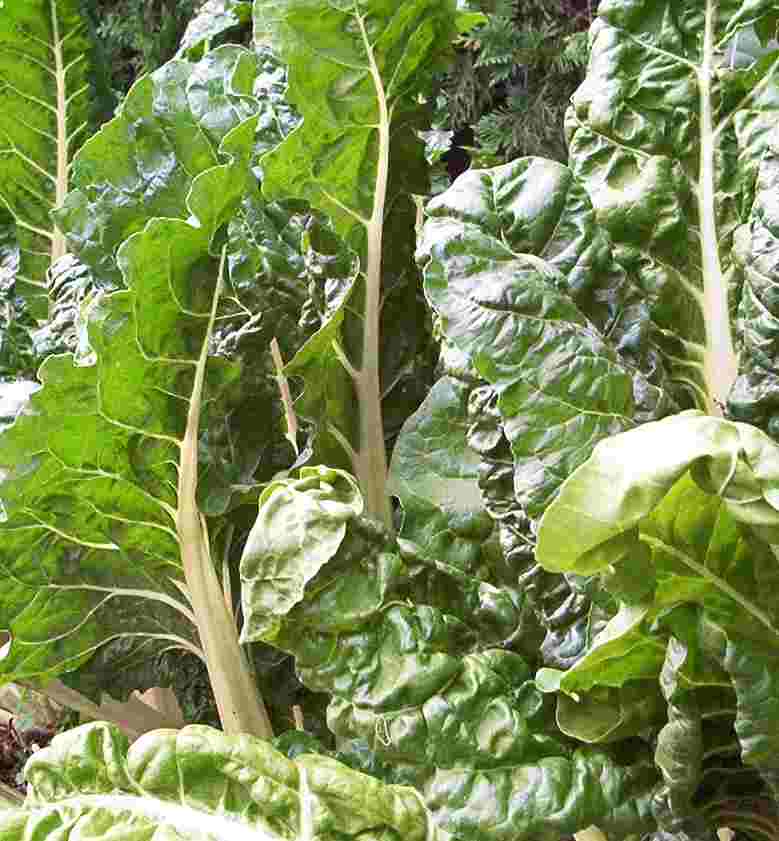
Two vegetables in one, Swiss chard offers its broad leaves to cook like spinach and its fleshy stems to bake in a gratin. Generous from June until the frosts, sometimes beyond, colourful in its red- and yellow-stemmed versions, it makes do with moist soil and forgives a great deal of neglect.
- Difficulty
- Easy
- Exhibition
- Sun or partial shade
- Watering
- Regular; water in summer gives tender stems and prevents bolting.
- Floor
- Deep, rich, moist, well-composted soil; tolerates heavy ground.
- Spacing
- 35 to 40 cm each way.
- Harvest
- 60 to 90 days.
Calendar · Belgian climate
When to sow, plant and harvest
| Activity | Jan | Feb | Mar | Apr | May | Jun | Jul | Aug | Sep | Oct | Nov | Dec |
|---|---|---|---|---|---|---|---|---|---|---|---|---|
| Sowing under cover | yes | |||||||||||
| Sowing in open ground | yes | yes | yes | yes | ||||||||
| Plantation | yes | yes | yes | yes | yes | |||||||
| Harvest | yes | yes | yes | yes | yes | yes | yes |
Step by step
1Sowing
Sow from April to July in place, in stations of two or three seed clusters every 35 cm, 2 cm deep, or in rows 40 cm apart. Each cluster gives several seedlings: thin to keep only one. A March sowing in pots under cover brings the harvest forward to June. Germination takes eight to fifteen days in soil kept moist.
2Planting out
Transplant pot-sown plants, or bought ones, when they have four or five leaves, every 35 to 40 cm, in soil enriched with compost. Set the crown at soil level, firm and water copiously. Chard is happy at the edge of a bed, at the foot of climbing beans or in a large balcony container at least 30 cm deep.
3Caring
Hoe and mulch as soon as the plants have taken. Water regularly in dry weather to keep the stems tender and prevent bolting. A watering of nettle liquid in June supports repeated picking. Remove flower stems as soon as they appear. Before winter, cover the plant with dead leaves or a fleece to try to keep the crown going until spring.
4Harvesting
Pick the outer leaves one by one, snapping them at the base with a sideways movement, as soon as they are 25 cm long, never taking the heart: the plant keeps regrowing for months. Two or three leaves per plant per week are enough for a family. The young leaves can be eaten raw, the large ones cooked with stem and green separated.
5Storing
Fresh leaves keep three or four days in the fridge in a bag, the stems up to a week. Blanched for two minutes, green and stems separated, they freeze easily. The stems can also be preserved in sterilised jars, in the manner of cardoons, or as a ready-made gratin to freeze. The best store remains the plant in the ground, picked day by day.
Further reading
Planting and caring for plants properly
How to plant properly
Choosing the spot
Chard accepts sun as well as partial shade, which makes it one of the few productive vegetables for a corner of the plot shaded in the afternoon by a hedge or wall. It prefers deep, moist soil, tolerates our heavy clays better than most leaf vegetables, and dislikes only standing water. Place it after a well-manured crop, cabbage or squash, and never after spinach or beetroot, its cousins, to avoid leaf miner and soil-borne diseases. At the edge of a bed, its large leaves usefully shade the base of climbing beans.
Preparing the soil
Loosen to 25 cm with a broadfork, as chard forms a fleshy taproot that goes down deep. Work in three to four kilos of mature compost per square metre, then rake the surface fine for an even seedbed. In the acid soils of the Ardennes or the Campine, a dressing of lime or wood ash the previous autumn suits it, chard liking neutral to slightly chalky soils. On capping loam, a light mulch of sieved compost along the row after sowing prevents the crust that blocks germination.
Sowing at the right time
Sow in open ground from April to July, once the soil reaches 10 °C, in practice after 10 April in the centre of the country. Each "seed" is a cluster containing several seeds: place them every 10 cm in a drill 2 cm deep, in rows 40 cm apart, or in stations of two or three every 35 cm. Cover, firm and keep moist until germination, in eight to fifteen days. Two sowings are enough for the whole year: one around 20 April for summer, one around 15 July for autumn and winter.
Sowing in pots for an early start
To pick from the end of May, sow in March under cover or on a cool windowsill, one seed cluster per 7 cm pot, at 15 to 18 °C. Keep only one seedling, or two for the thin-stemmed varieties intended for picking as young leaves. Harden off from early April under a cold frame. Chard transplanted before six weeks in the pot and without breaking the root ball shows no check at all, contrary to what is often written. Do, however, avoid letting it suffer persistent cold below 5 °C in the pot: the plant, a biennial, would take it for a winter and bolt in June.
Thinning and transplanting
When plants sown in place have four leaves, thin to keep one plant every 35 to 40 cm for the thick-stemmed varieties, 20 cm for cut-and-come-again chard. The pulled seedlings can be transplanted elsewhere the same evening, root pushed well in with a dibber, or eaten as young shoots. Plant pot-grown and shop-bought plants from April to August, the crown exactly at soil level, in a hole watered beforehand. Firm and water another litre per plant. A light mulch of dried grass clippings laid the next day protects against capping and slugs.
In a pot or container
Chard does very well in a container 30 cm deep, one plant every 25 cm, or a single plant in a pot 25 cm across for the coloured varieties, which are as decorative as they are productive. Fill with potting compost enriched with a third of garden compost over clay pebbles, place in sun or partial shade, and water as soon as the surface dries, every two days in summer. A liquid organic feed every three weeks supports repeated picking. A container sheltered against a wall comes through the winter and gives leaves again in March.
Beginner's mistakes
The first mistake is sowing too densely without thinning: the multiple seed clusters give tight clumps of puny leaves. The second is sowing in cold soil in March or planting out pots too early, which causes early bolting with no stems to harvest. The third is cutting the heart at harvest instead of taking the outer leaves. Finally, many gardeners plant ten plants when three or four feed a family from the end of May to December. Sow little, thin boldly, pick often.
Look after it properly
Watering just right
Chard survives a dry spell without dying, but its stems then become fibrous and bitter, and the plant flowers. Water copiously once or twice a week in summer, eight to ten litres per square metre, at the base and preferably in the evening, keeping the soil moist under the mulch. A week of heat without water in July does more damage than a month of rain. In pots, check every day. In spring and autumn, our rainfall is almost always enough. Leaves that droop at midday and rise again in the evening do not signal a shortage; only morning wilting does.
Mulching and feeding
As soon as the plants are 15 cm tall, mulch 5 cm deep with dried grass clippings, straw or shredded leaves, keeping the crown clear to avoid rot. Chard is hungry for nitrogen to renew its foliage: a watering of nettle liquid diluted to 10 % every three weeks from June to September, or a handful of compost at the base each month, keeps production steady. A plant whose leaves turn pale is simply asking for food. Avoid fresh manure, which gives leaves loaded with nitrates and attracts aphids.
Picking to renew
Chard produces all the more for being picked. Take two or three outer leaves per plant per week, snapping them at the base with a sharp sideways movement, or with a knife 3 cm from the crown, never touching the four or five leaves of the heart. Old leaves left in place yellow and exhaust the plant: remove them even if you do not use them. Remove any flower stem as soon as it appears, thick and without broad leaves, cutting it flush: the plant then carries on giving for several weeks. A tired plant, cut back entirely to 5 cm and watered with liquid feed, starts again within ten days.
Preventing diseases and pests
Beet leaf miner bores brown galleries in the leaves from April to June: lay insect-proof mesh over young sowings, and cut off and destroy any mined leaf, eggs included, as soon as you spot it. Slugs attack mainly the young plants: coarse mulch, collection at dusk, trap boards. In a wet summer, cercospora leaf spot dots the leaves with round spots edged in red; give air by spacing, water at the base, remove affected leaves and spray a horsetail decoction. Black aphids are dislodged with a jet of water or soft soap at 5 %. A three-year rotation without beetroot or spinach avoids most of this.
Through the season
Late April, summer sowing under mesh against leaf miner. May, thinning, mulching, first picking from the March plants. June to August, regular watering, nettle liquid, weekly picking, removal of flower stems. Mid-July, second sowing for autumn. September, planting the young summer plants in spaces freed by onions or potatoes. October-November, abundant harvest; the leaves sweetened by the first frosts are excellent. December, thick mulch of dead leaves and double fleece over the plants. March, cleaning off damaged leaves and first pickings from the overwintered crown before it flowers in May.
Harvesting and extending the season
Pick as soon as the outer leaves are 20 to 25 cm long, about eight weeks after sowing, and carry on until the hard frosts. Chard withstands -5 °C without protection and down to -10 °C under a thick fleece or a 20 cm layer of dead leaves: in most of our winters, some of the plants survive and give tender leaves again from mid-March, before flowering in May. A cold frame or low tunnel extends picking all winter. Cut the broad stems and the green separately, as they do not cook at the same rate. For very young salad leaves, sow a cut-and-come-again variety densely and shear to 3 cm every month.
Obtaining seeds or seedlings
Seeds and seedlings: where to find them
A selection of reputable seed suppliers that deliver to your country, listed in order of proximity. Evadya does not receive any commission: these are suppliers we recommend for their reliability.
Semailles
For Belgian artisan seed producer, organic and reproducible seeds, over 250 regional varieties, a planting calendar tailored to the Belgian climate.
Against Small organisation: limited range of hybrid varieties and possible stock shortages during peak season.
Search for ‘swiss chard’ on SemaillesKokopelli
For Europe’s largest collection of heirloom, organic and open-pollinated varieties; comprehensive growing guides.
Against No hybrids or seedlings; delivery times can sometimes be long during peak season; prices are slightly higher.
View the shopFerme de Sainte Marthe
For A long-established organic seed supplier, offering seeds and young plants, heirloom varieties, and nutrition and recipe guides.
Against Dispatched from the Loire: postage charges to Belgium and Switzerland; plants are fragile in transit.
Search for ‘swiss chard’ on Ferme de Sainte MartheGraines Baumaux
For A vast selection (over 500 tomato varieties), with high-yielding F1 hybrids and heirloom varieties side by side, and plants available in season.
Against Not much organic produce; an old site; catalogue entries rather than growing guides.
Search for ‘swiss chard’ on Graines BaumauxVreeken’s Zaden
For A very wide range of Dutch products, competitive prices, and numerous varieties suited to the Benelux climate.
Against Website in Dutch only; limited selection of organic produce.
Search for ‘swiss chard’ on Vreeken’s ZadenDe Bolster
For Dutch organic seed producer, seeds suitable for propagation, a good selection for cool climates.
Against A shorter catalogue; website in Dutch.
Search for ‘swiss chard’ on De BolsterZollinger Bio
For Swiss organic seeds, varieties suited to high altitudes and microclimates, and a unique phenological calendar.
Against Swiss prices and customs charges from the European Union.
Search for ‘swiss chard’ on Zollinger BioBingenheimer Saatgut
For A leading German name in organic and biodynamic produce, offering open-pollinated varieties selected for the home gardener.
Against Website in German; delivery charges apply outside Germany.
Search for ‘swiss chard’ on Bingenheimer SaatgutDreschflegel
For A collective of organic growers, specialising in rare and regional varieties, and the preservation of traditional farm seeds.
Against Small quantities; a catalogue that’s more activist than practical; website in German.
Search for ‘swiss chard’ on DreschflegelFrom the vegetable patch to the plate
And then we savour it
What it offers
Leaves rich in vitamin K, beta-carotene, magnesium and fibre; the stems are mostly water and potassium.
In the kitchen, it’s simple
A gratin of chard stems with béchamel and Gruyère, and the green wilted in butter with garlic, to accompany a piece of meat.
Living well
This plant that gives for months on end without asking for anything is a reminder that the vegetable garden is also a school of quiet patience.
Also worth a look
Other vegetables
Leek
Allium porrum
Lettuce
Lactuca sativa
Spinach
Spinacia oleracea
Lamb's lettuce (corn salad)
Valerianella locusta