root vegetable · Apiacées
CeleriacApium graveolens var. rapaceum
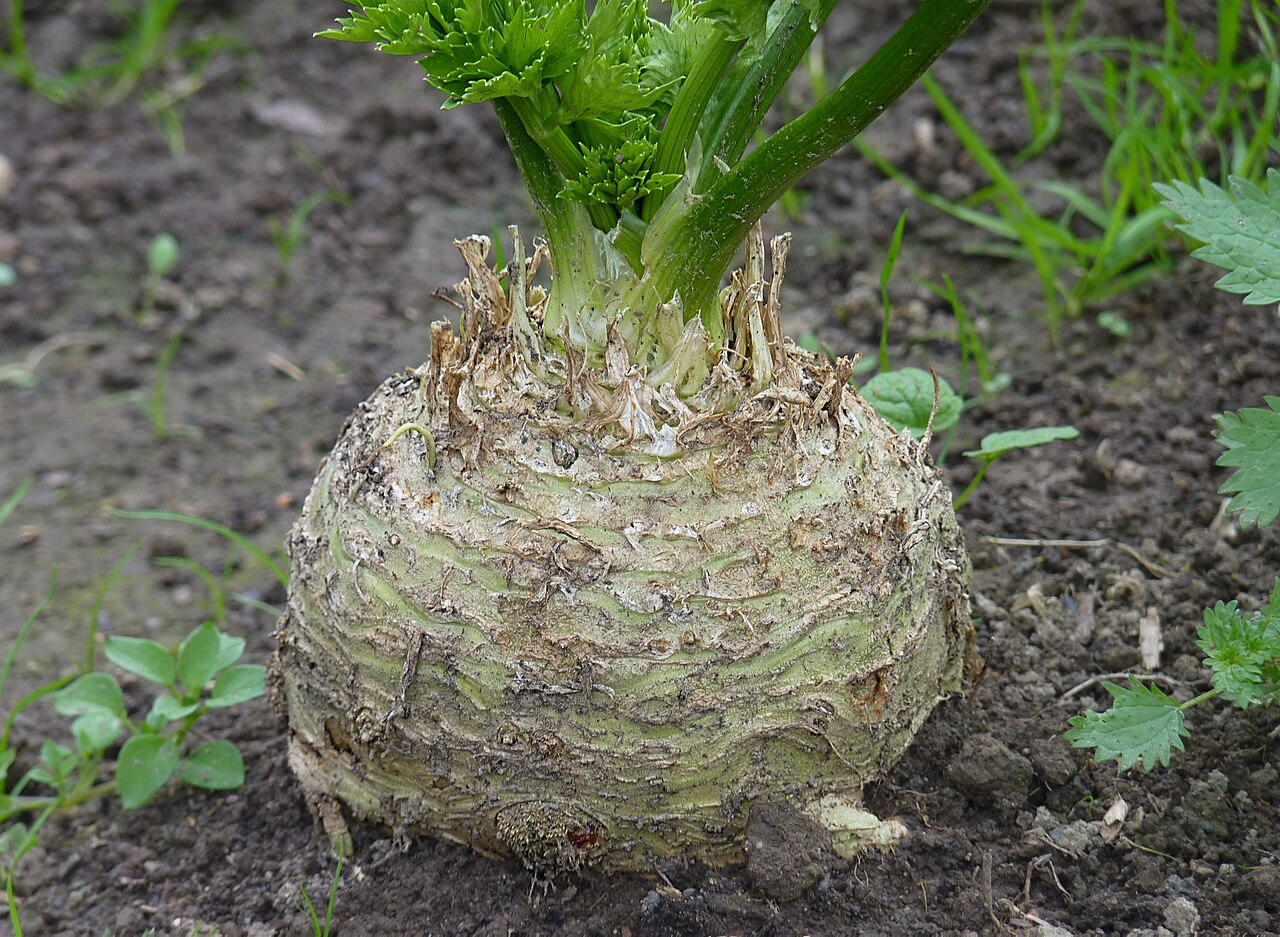
Beneath its rough skin, celeriac hides white, fragrant flesh that perfumes winter soups and purées. It is a long crop, from February to October, and it demands rich soil and water without stinting; but a fine root of over a kilo keeps all winter.
- Difficulty
- Demanding
- Exhibition
- Sun
- Watering
- Abundant and regular all summer; it is a plant of moist ground that stops swelling the moment it is thirsty.
- Floor
- Deep soil, very rich in humus, moist but drained, generously composted.
- Spacing
- 35 to 40 cm each way.
- Harvest
- 200 to 240 days from sowing.
Calendar · Belgian climate
When to sow, plant and harvest
| Activity | Jan | Feb | Mar | Apr | May | Jun | Jul | Aug | Sep | Oct | Nov | Dec |
|---|---|---|---|---|---|---|---|---|---|---|---|---|
| Sowing under cover | yes | yes | ||||||||||
| Plantation | yes | yes | ||||||||||
| Harvest | yes | yes | yes |
Step by step
1Sowing
Sow in February-March in warmth, at 18 to 20 °C, in a seed tray, on the surface: the seeds need light to germinate, so barely cover them. Germination is slow, two to three weeks. Prick out into pots as soon as the seedlings can be handled, barely burying the crown. Harden off gradually in April under a cold frame. A late sowing gives small roots.
2Planting out
Plant after the Ice Saints, mid-May to early June, using plants of about 10 cm with five or six leaves. A prolonged cold spell below 10 °C would make the plants bolt. Set them out every 35 to 40 cm, with the crown at soil level, never buried, in soil very rich in compost. Water generously and shade for a few days if the sun is strong.
3Caring
Water relentlessly in dry weather, at least twice a week, and mulch thickly from June. Hoe until the mulch is in place. Feed every fortnight with nettle or comfrey liquid until August. From late August, remove the outer leaves lying on the ground and clear the soil away from around the root so that it swells nice and round and cleans itself up.
4Harvesting
Lift with a garden fork from October to mid-November, before the hard frosts, when the roots are 10 to 15 cm across. A light frost does not harm them, but a sharp cold snap splits them. Cut the leaves back to 2 cm and the roots flush, and brush off the soil without washing. Keep the tender leaves from the heart to flavour a stock.
5Storing
Celeriac keeps all winter in a cool cellar, in slightly damp sand or simply in crates, leaves cut off. In the fridge, a whole root lasts several weeks, a cut one a week wrapped in film. It freezes as diced pieces blanched for three minutes, and above all as purée or velouté, ready to reheat on weekday evenings.
Further reading
Planting and caring for plants properly
How to plant properly
Choosing the spot
Celeriac wants sun, but above all soil that stays moist all summer. Give it the deepest, most humus-rich bed in the vegetable garden, the one that received manure the previous autumn, in a corner where the soil does not dry out in July. Avoid windswept spots, which dry the leaves, and low-lying hollows where water stands in winter. Place it in the rotation after a hungry crop such as cabbage or leek, and never two years running in the same spot, nor after carrots or parsley, which share its pests.
Preparing the soil
From autumn, or by March at the latest, loosen the bed with a broadfork to 25 or 30 cm without turning the soil, then work in five to six kilos of mature compost or well-rotted manure per square metre. In our clay soils, add a barrowload of coarse sand or leaf mould to improve drainage. A handful of sieved wood ash provides the potash it appreciates. At planting time, the surface should be crumbled to 10 cm, free of clods, so that the young roots settle in without difficulty.
Sowing at the right time
Sow between 15 February and 15 March, in warmth, at 18 or 20 °C, in a seed tray of fine sieved seed compost. The seeds are tiny: mix them with dry sand to sow thinly, press them onto the surface and cover with a millimetre of vermiculite at most, as they need light. Cover the tray with a transparent lid, keep moist with a mister and allow two to three weeks of patience. A sowing after mid-March gives nothing but small roots, the Belgian season being too short to catch up.
Pricking out into pots
When the seedlings carry two true leaves, around the end of March, prick them out one by one into 7 cm pots filled with potting compost enriched with a third of sieved garden compost. Hold them by a leaf, never by the stem, and bury them at the same depth as in the tray, with the crown just at the surface. Place them in full light, at 15 or 16 °C, and water from below so as not to flatten the plants. From mid-April, put them out by day under a cold frame or against a sheltered wall, and bring them in if the night threatens to drop below 8 °C: persistent cold would make them flower in summer.
Planting after the Ice Saints
Plant between 15 May and 10 June, on an overcast evening, using plants of 10 to 12 cm carrying five or six leaves. Make a hole with a dibber every 35 to 40 cm, in rows 40 to 45 cm apart, and set the root ball so that the crown stays exactly at soil level: a celeriac planted too deep makes a misshapen root and rots at the heart. Firm with the fingertips, water from the spout, a litre per plant, and mulch straight away with two or three centimetres of dried grass clippings. Lay insect-proof mesh the same day against celery fly.
In a large container
Growing in a pot is possible, but only in a container 40 cm deep and as wide, one plant per container, filled with a mix of half potting compost, half garden compost, with a layer of clay pebbles at the bottom. The container must stand in sun but out of the wind, and be watered almost every day in July-August, because the root stops swelling at the first dry spell. Allow a liquid organic feed every fortnight from June to the end of August. The result is more modest than in open ground, but a 500 g root on a terrace is a fine success.
Beginner's mistakes
The first mistake is a late sowing, in April, which condemns you to harvesting roots the size of an apple. The second is planting too early, in early May, in soil still cold: the plant thinks it is in its second year and runs to flower. The third is a buried crown, which smothers the root. Finally, many gardeners forget that celeriac drinks enormously and plant it in a dry corner, next to the Mediterranean herbs. Keep the plants cool, water without stinting and remove any competitors within 30 cm.
Look after it properly
Watering without ever letting it dry out
Celeriac comes from coastal marshes and has lost none of its thirst. Give ten to fifteen litres per square metre twice a week whenever it is not raining, more in a heatwave, always at the base and preferably in the evening. The test is simple: push a finger into the soil beneath the mulch, and it should stay moist along its whole length. Alternating drought and copious watering splits the root and makes it fibrous. A porous hose laid under the mulch, connected to a rainwater butt, settles the question for the whole summer.
Mulching thickly and feeding
As soon as the plants have taken, around mid-June, lay a mulch of 5 to 8 cm of dried grass clippings, chopped straw or shredded leaves, topping it up as it breaks down. It keeps the soil cool, reduces hoeing and feeds slowly. Add a watering of nettle liquid diluted to 10 % every fortnight in June and July, then comfrey liquid, richer in potash, in August for swelling. A dressing of compost on the surface at the start of summer, under the mulch, is appreciated. Stop all feeding in early September.
Clearing the root in late summer
From late August, when the root reaches the size of a tennis ball, gently push the soil and mulch away from around it to expose the top third to the air. Cut off with a knife the side rootlets growing from the exposed part and remove the outer leaves that have yellowed or lie on the ground, without touching the central tuft. This step, repeated two or three times until October, gives a round, smooth root that is easy to peel. Do not clear any deeper, or the root would turn bitter and go green.
Preventing diseases and pests
Celery fly lays in the leaves from April to September; fine insect-proof mesh laid over hoops from planting remains the only effective protection. Remove and destroy any leaf showing pale galleries. Against septoria leaf spot, which marks the foliage in damp weather, water at the base, give air by spacing well, and spray a horsetail decoction every ten days in summer. Slugs and snails nibble the young plants: pick them off in the evening, use trap boards and a coarse mulch for the first few weeks. Rust is kept in check by avoiding excess nitrogen.
Through the season
Late May, planting under mesh and a light mulch. June, hoeing before the final mulch and first nettle liquid. July and August, diligent watering, topping up the mulch, checking the mesh. Late August, first clearing of the root and removal of the lower leaves. September, comfrey liquid, second clearing. October, stop watering about ten days before harvest so that the root keeps better. Note in your notebook the sowing date and the size obtained: it is the best guide for adjusting the following year.
Harvesting and extending the season
Harvest from October to mid-November, as soon as the roots are 10 to 15 cm across, lifting with a garden fork rather than pulling. A light white frost does not harm them and even sweetens their flavour, but bring everything in before a forecast frost below -3 °C. To keep them in the garden until December in our milder regions, cover the plants with a thick fleece and 20 cm of dead leaves. In a cool cellar, roots buried in slightly damp sand keep until March. Set one plant aside to let it flower the following year and feed the hoverflies.
Obtaining seeds or seedlings
Seeds and seedlings: where to find them
A selection of reputable seed suppliers that deliver to your country, listed in order of proximity. Evadya does not receive any commission: these are suppliers we recommend for their reliability.
Semailles
For Belgian artisan seed producer, organic and reproducible seeds, over 250 regional varieties, a planting calendar tailored to the Belgian climate.
Against Small organisation: limited range of hybrid varieties and possible stock shortages during peak season.
Search for ‘celeriac’ on SemaillesKokopelli
For Europe’s largest collection of heirloom, organic and open-pollinated varieties; comprehensive growing guides.
Against No hybrids or seedlings; delivery times can sometimes be long during peak season; prices are slightly higher.
View the shopFerme de Sainte Marthe
For A long-established organic seed supplier, offering seeds and young plants, heirloom varieties, and nutrition and recipe guides.
Against Dispatched from the Loire: postage charges to Belgium and Switzerland; plants are fragile in transit.
Search for ‘celeriac’ on Ferme de Sainte MartheGraines Baumaux
For A vast selection (over 500 tomato varieties), with high-yielding F1 hybrids and heirloom varieties side by side, and plants available in season.
Against Not much organic produce; an old site; catalogue entries rather than growing guides.
Search for ‘celeriac’ on Graines BaumauxVreeken’s Zaden
For A very wide range of Dutch products, competitive prices, and numerous varieties suited to the Benelux climate.
Against Website in Dutch only; limited selection of organic produce.
Search for ‘celeriac’ on Vreeken’s ZadenDe Bolster
For Dutch organic seed producer, seeds suitable for propagation, a good selection for cool climates.
Against A shorter catalogue; website in Dutch.
Search for ‘celeriac’ on De BolsterZollinger Bio
For Swiss organic seeds, varieties suited to high altitudes and microclimates, and a unique phenological calendar.
Against Swiss prices and customs charges from the European Union.
Search for ‘celeriac’ on Zollinger BioBingenheimer Saatgut
For A leading German name in organic and biodynamic produce, offering open-pollinated varieties selected for the home gardener.
Against Website in German; delivery charges apply outside Germany.
Search for ‘celeriac’ on Bingenheimer SaatgutDreschflegel
For A collective of organic growers, specialising in rare and regional varieties, and the preservation of traditional farm seeds.
Against Small quantities; a catalogue that’s more activist than practical; website in German.
Search for ‘celeriac’ on DreschflegelFrom the vegetable patch to the plate
And then we savour it
What it offers
A low-calorie root, rich in fibre, potassium and vitamin K, with a fragrance that comes from its essential oils.
In the kitchen, it’s simple
Celeriac rémoulade, finely grated with a mustardy mayonnaise, or a purée of half celeriac, half potato under a Flemish beef carbonade.
Living well
Brushing the soil off your roots on a Saturday in October and stowing them in the cellar is a quiet way of preparing the soups of the dark evenings ahead.
Also worth a look