herb · Apiacées
DillAnethum graveolens
Dill, the feathery cousin of fennel, flavours fish, cucumbers and new potatoes with its fresh aniseed note. An easy annual, it is sown in place from April to July and sometimes self-seeds; its large yellow umbels draw a crowd of useful insects into the vegetable garden.
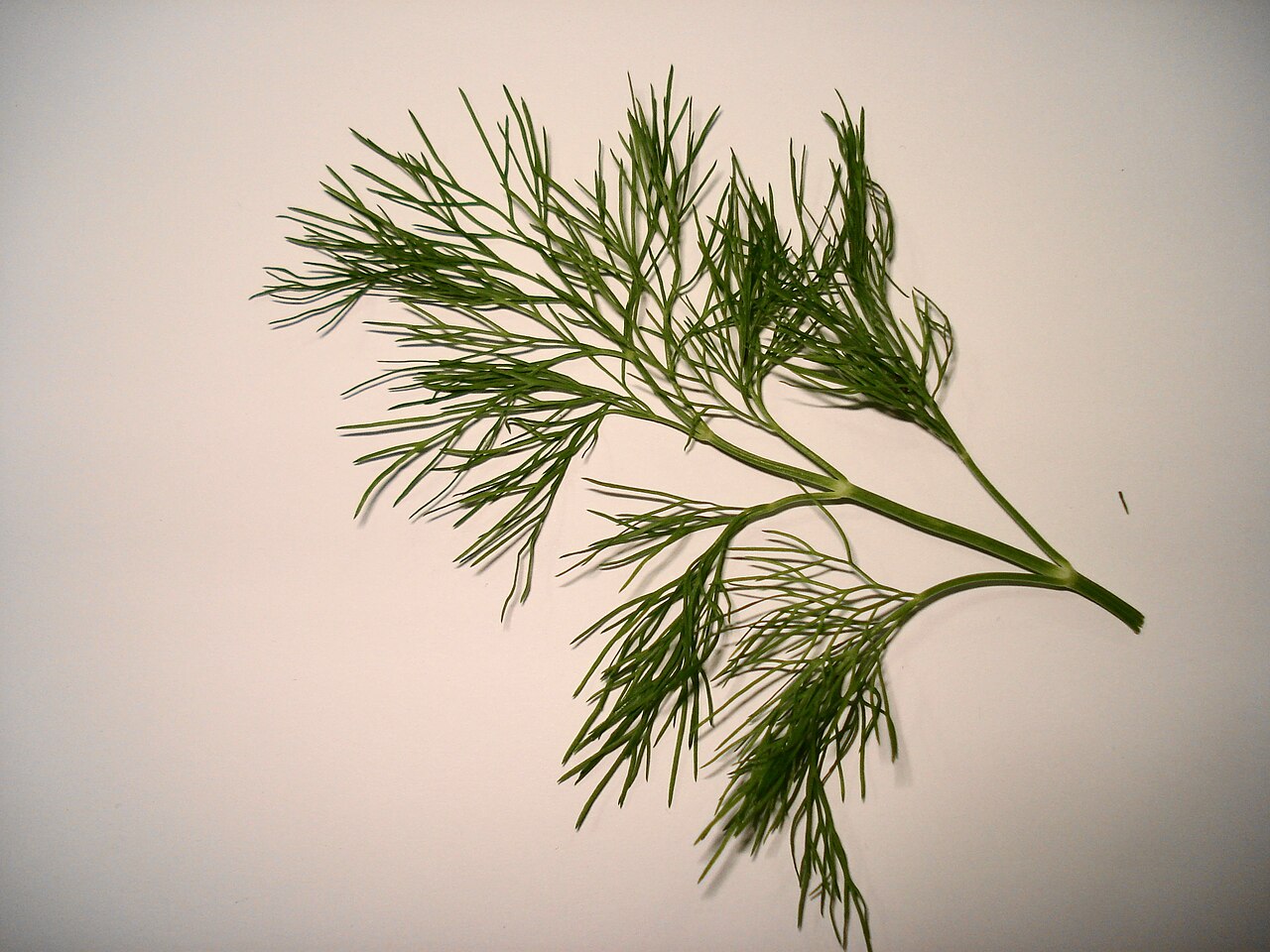
- Difficulty
- Easy
- Exhibition
- Sun, sheltered from wind
- Watering
- Moderate and regular; tolerates neither prolonged drought nor excess water.
- Floor
- Light, moist, well-drained, moderately rich soil.
- Spacing
- 20 to 25 cm between plants, 30 cm between rows.
- Harvest
- 45 to 60 days for the leaves, 90 to 120 for the seeds.
Calendar · Belgian climate
When to sow, plant and harvest
| Activity | Jan | Feb | Mar | Apr | May | Jun | Jul | Aug | Sep | Oct | Nov | Dec |
|---|---|---|---|---|---|---|---|---|---|---|---|---|
| Sowing in open ground | yes | yes | yes | yes | ||||||||
| Harvest | yes | yes | yes | yes | yes |
Step by step
1Sowing
Sow in place from late April to July, in rows 30 cm apart, one centimetre deep, in fine, warmed soil. Germination in ten to fifteen days. Sow thinly and repeat every four weeks for a continuous supply of tender leaves. In a pot, choose a deep container, as dill has a taproot; a March sowing under cover gives hardly any head start.
2Planting out
Dill does not transplant willingly: sow it in place, as the slightest stress to the root makes it flower prematurely. Shop-bought pot plants are planted keeping the root ball intact, every 20 cm, with a copious watering. Set it near the cucumbers and cabbages, which it accompanies well, but away from carrots and fennel, with which it hybridises or competes.
3Caring
Thin to 20 cm, hoe and mulch lightly to keep the soil cool. Water moderately but regularly in dry weather. The tall varieties reach a metre and flop in the wind: stake them or sow them in shelter. Pinch out the first umbels if you want to prolong the leaf harvest; then let it flower, the beneficial insects will make the most of it.
4Harvesting
Pick the fine, feathery leaves as you go, with scissors, as soon as the plant is 20 cm tall, preferably in the morning and before flowering, when they are most fragrant. The green umbels still in flower flavour gherkins. For the seeds, cut the umbels when they turn brown in August-September and finish drying upside down in a paper bag.
5Storing
Fresh leaves last three or four days in the fridge, in a damp cloth. They freeze very well, chopped in ice cubes or whole in a bag, and then keep their scent far better than dried. The seeds keep two years in a sealed jar. A dill vinegar, or gherkins and cucumbers pickled in vinegar flavoured with an umbel, keep all winter.
Further reading
Planting and caring for plants properly
How to plant properly
Choosing the spot
Dill wants sun and above all shelter from wind: its metre-tall hollow stems flop at the first summer storm in an exposed garden. Sow it against a hedge, between rows of climbing beans or cabbages, at the foot of a wire fence, or in a container near a wall. It likes light, moist soil, neither dry nor compact, and does better on our drained loams than on heavy clays. Keep it away from carrots, with which it can hybridise if you are saving seed, and from fennel, its close cousin. Cucumbers and cabbages are its best neighbours.
Preparing the soil
Loosen to 20 or 25 cm for the taproot, without turning, and work in one or two kilos of mature compost per square metre; dill makes do with moderately rich soil and loses its scent in ground that is too well fed. Rake the surface fine for a fine seedbed. On clay, mix coarse sand into the seed row and raise the bed slightly. Above all, wait for the soil to warm up: a soil thermometer pushed in to 5 cm should read 12 °C, which rarely happens before the end of April here.
Sowing at the right time
Sow in place from late April to mid-July, in two or three batches four weeks apart, a one-metre row each time. Draw drills 1 cm deep and 30 cm apart, sow thinly, one seed every 3 cm, cover with fine compost and firm. Keep moist without excess: germination takes ten to fifteen days and the seeds rot in cold, sodden soil. The first sowing, around 25 April, gives leaves for the new potatoes of June; the early July one accompanies cucumbers and gherkins in August-September.
Choosing the variety
For the leaves, prefer varieties with dense foliage that are slow to flower, such as Dukat, Tetra or Fernleaf, the last a dwarf and perfect in a pot. For the umbels and seeds, common dill or Mammoth reaches 1.20 m and flowers quickly. Buy this year's seed, as dill loses its viability in two or three years, or harvest your own from a plant left to flower. Shop-bought pot plants, often sown densely and drawn, bolt as soon as they are planted; if you take one, plant it with its root ball intact and pick it within a fortnight.
Thinning without transplanting
Dill hates being moved: an injured taproot triggers flowering. So sow in place and thin in two stages, to 10 cm when the plants have three leaves, then to 20 cm a fortnight later; the pulled seedlings are eaten at once, chopped over fromage frais. If you absolutely want a head start, sow in March in biodegradable pots, three seeds per pot, and plant the whole pot as soon as the seedlings have two true leaves, without waiting. Water at sowing and at thinning, then let the root seek water at depth.
In a pot or container
In a pot, dill needs depth, 25 cm at least, in a container 30 cm across placed in sun but sheltered from wind, against a wall or balustrade. Ordinary potting compost lightened with a third of sand, drainage with clay pebbles. Sow directly about ten split seeds on the surface, thin to three or four plants, water as soon as the surface dries, every two days in summer. Choose a dwarf variety such as Fernleaf, which stays at 40 cm without a stake. Resow a second pot a month after the first to prolong the tender leaves until September.
Beginner's mistakes
Sowing in March or early April in soil at 8 °C: the seeds rot and the gardener blames the packet. Transplanting seedlings or buying an already tall garden centre pot: flowering within ten days. Sowing a single long row in May and ending up with twenty plants in flower at once in July, with no leaves. Forgetting the stake or the shelter, and finding the stems flattened after the storm. Finally, pulling up the bolted plants, when the yellow umbels in flower are precisely what you need for gherkins and to attract the hoverflies that will rid the rest of the vegetable garden of aphids.
Look after it properly
Watering moderately
Dill sits between two extremes: prolonged drought makes it flower and yellow, standing water rots its root. Water four to five litres per square metre once or twice a week in dry weather, at the base, preferably in the morning, letting the surface dry between waterings. Sowings still coming up, though, stay permanently moist. In a pot, water every two days in summer, with no full saucer. A dill that droops in the morning lacks water; a dill that pales and whose lower leaves yellow in damp soil has too much.
Mulching and feeding
After the second thinning, mulch the row lightly, 2 to 3 cm of dried grass clippings or flax shives, to keep the soil cool and reduce hoeing, which injures the shallow roots. As for feeding, dill makes do with the compost given at sowing; a single watering of nettle liquid diluted to 5 % after the first picking relaunches the foliage. Too much nitrogen gives long, fragile, scentless stems. In a pot, a half-dose of liquid organic feed every three weeks is enough. Weed by hand, as young dill copes badly with competition from weeds.
Staking, pinching, letting it flower
As soon as the plants exceed 40 cm, stretch a string between two stakes on either side of the row, or push a few dry twiggy branches in between the plants: they will lean on them without flopping. Pinch out the first umbels as they form on the plants intended for leaves, which prolongs picking by two or three weeks. Let the others flower: the yellow umbels, as wide as a hand, are useful in the kitchen and to beneficial insects. Dill is not perennial and renews itself only by seed; let a few seeds fall to the ground, and it often self-seeds the following spring.
Preventing diseases and pests
Dill attracts aphids in June, often on the umbels; a jet of water, soft soap at 5 % or a little patience are enough, because its own flowers draw hoverflies and ladybirds in numbers, which clean everything up within a week. Slugs crunch the seedlings as they come up: ash and evening collection. Swallowtail caterpillars sometimes devour a whole plant; leave them, this rare butterfly deserves a dill. In a wet summer, rot at the crown or spots on the leaves call for wider spacing and watering at the base. Alternate the spot each year with the other umbellifers.
Through the season
Late April, first sowing in warmed soil. May, thinning in two stages, light mulch, protection against slugs. Early June, first leaf pickings, second sowing, staking. July, pinching umbels on the leaf plants, umbels in flower for the gherkins, third sowing. August, leaf harvest from the late sowings, seeds browning on the spring plants. September, seed harvest, last leaves. October, pulling up the dry plants, a few seeds left on the ground for a self-sown crop. November to April, nothing in the garden; the seeds and frozen leaves keep the kitchen going.
Harvesting and extending the season
Pick the leaves with scissors as soon as the plant is 20 cm tall, six to eight weeks after sowing, in the morning, taking the outer fronds at their base and never more than a third of the plant at once. The scent is finest just before flowering. To extend the leaf season until October, stagger the sowings until mid-July and cover the last row with a fleece on the first cool nights. The umbels are cut in flower for the jars, then browned for the seeds, which are finished off drying upside down in a paper bag. Dill does not come through the winter; it self-seeds.
Obtaining seeds or seedlings
Seeds and seedlings: where to find them
A selection of reputable seed suppliers that deliver to your country, listed in order of proximity. Evadya does not receive any commission: these are suppliers we recommend for their reliability.
Semailles
For Belgian artisan seed producer, organic and reproducible seeds, over 250 regional varieties, a planting calendar tailored to the Belgian climate.
Against Small organisation: limited range of hybrid varieties and possible stock shortages during peak season.
Search for ‘dill’ on SemaillesKokopelli
For Europe’s largest collection of heirloom, organic and open-pollinated varieties; comprehensive growing guides.
Against No hybrids or seedlings; delivery times can sometimes be long during peak season; prices are slightly higher.
View the shopFerme de Sainte Marthe
For A long-established organic seed supplier, offering seeds and young plants, heirloom varieties, and nutrition and recipe guides.
Against Dispatched from the Loire: postage charges to Belgium and Switzerland; plants are fragile in transit.
Search for ‘dill’ on Ferme de Sainte MartheGraines Baumaux
For A vast selection (over 500 tomato varieties), with high-yielding F1 hybrids and heirloom varieties side by side, and plants available in season.
Against Not much organic produce; an old site; catalogue entries rather than growing guides.
Search for ‘dill’ on Graines BaumauxVreeken’s Zaden
For A very wide range of Dutch products, competitive prices, and numerous varieties suited to the Benelux climate.
Against Website in Dutch only; limited selection of organic produce.
Search for ‘dill’ on Vreeken’s ZadenDe Bolster
For Dutch organic seed producer, seeds suitable for propagation, a good selection for cool climates.
Against A shorter catalogue; website in Dutch.
Search for ‘dill’ on De BolsterZollinger Bio
For Swiss organic seeds, varieties suited to high altitudes and microclimates, and a unique phenological calendar.
Against Swiss prices and customs charges from the European Union.
Search for ‘dill’ on Zollinger BioBingenheimer Saatgut
For A leading German name in organic and biodynamic produce, offering open-pollinated varieties selected for the home gardener.
Against Website in German; delivery charges apply outside Germany.
Search for ‘dill’ on Bingenheimer SaatgutDreschflegel
For A collective of organic growers, specialising in rare and regional varieties, and the preservation of traditional farm seeds.
Against Small quantities; a catalogue that’s more activist than practical; website in German.
Search for ‘dill’ on DreschflegelFrom the vegetable patch to the plate
And then we savour it
What it offers
Leaves rich in vitamin C and beta-carotene; the seeds are a source of essential oils and calcium.
In the kitchen, it’s simple
Cucumber with fromage frais and dill, homemade salmon or trout gravlax, or warm new potatoes with butter and snipped dill.
Living well
Watching the hoverflies work the dill umbels on a July afternoon is a lesson in ecology that costs nothing.
Also worth a look