leaf vegetable · Brassicacées
RocketEruca vesicaria subsp. sativa
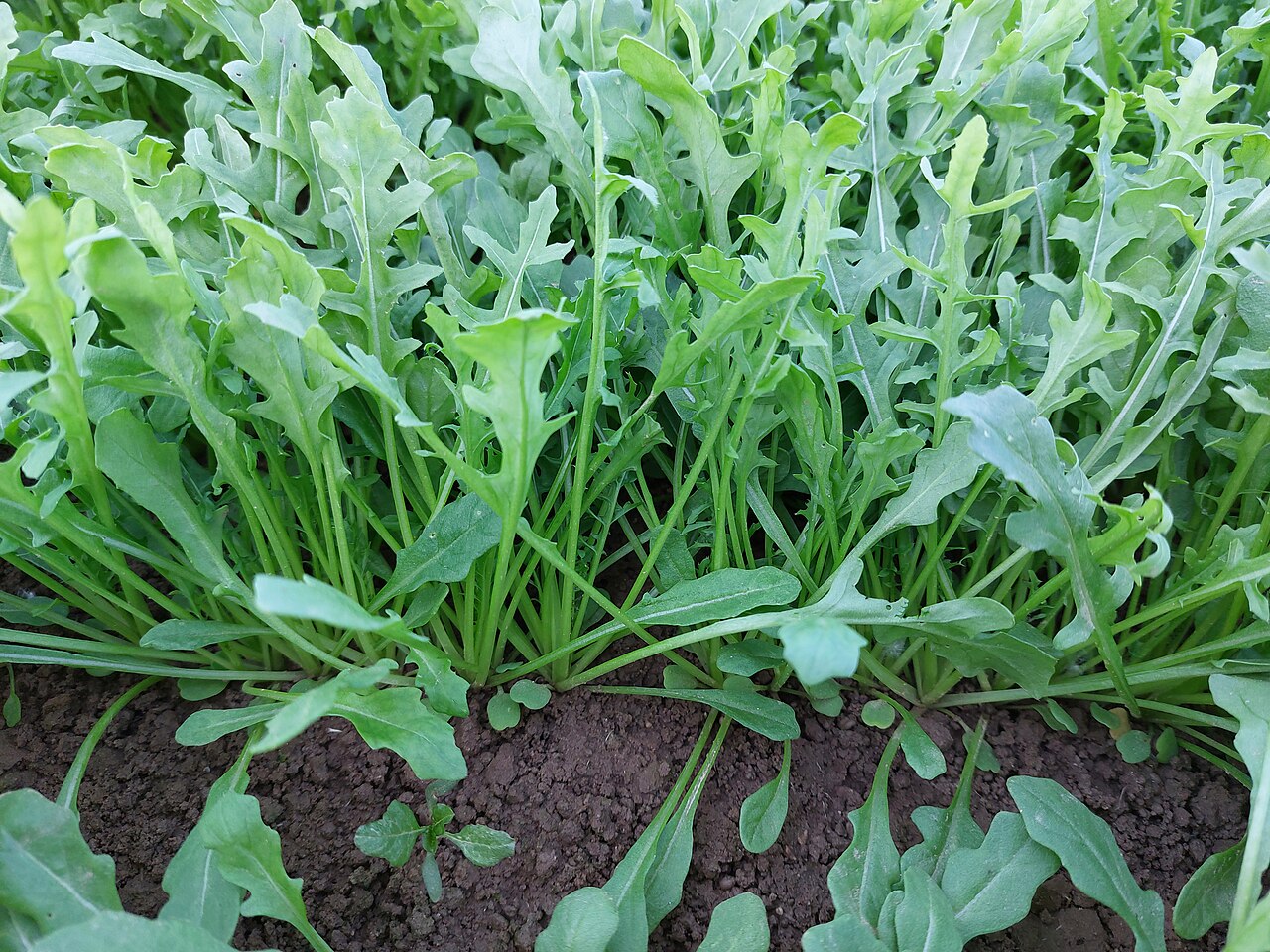
Peppery, lively, ready in a month, rocket is the fastest leafy green in the vegetable garden. It is sown in small quantities from spring to autumn, in open ground or in a balcony window box, and livens up salads, pizzas and open sandwiches without ever asking for much effort.
- Difficulty
- Easy
- Exhibition
- Sun in spring, partial shade in summer
- Watering
- Regular and light; a shortage of water makes the leaves bitter and hastens bolting.
- Floor
- Any ordinary soil, moist and loose; tolerates poor ground.
- Spacing
- Rows every 20 cm, plants thinned to 10 cm.
- Harvest
- 30 to 45 days.
Calendar · Belgian climate
When to sow, plant and harvest
| Activity | Jan | Feb | Mar | Apr | May | Jun | Jul | Aug | Sep | Oct | Nov | Dec |
|---|---|---|---|---|---|---|---|---|---|---|---|---|
| Sowing under cover | yes | yes | ||||||||||
| Sowing in open ground | yes | yes | yes | yes | yes | yes | yes | |||||
| Harvest | yes | yes | yes | yes | yes | yes | yes | yes |
Step by step
1Sowing
Sow from March under fleece, then outdoors every twenty days until September. Draw shallow drills, one centimetre at most, 20 cm apart, and scatter the seed thinly. Cover with fine soil, firm and water with a spray. Germination takes four to eight days. A sowing in a container on the balcony works just as well, in 15 cm of potting compost.
2Planting out
Rocket does not take kindly to transplanting: sow it in place. If you buy pots from a garden centre, knock them out without breaking the root ball, plant every 10 cm and water at once. Give it the edges of beds, the gaps between tomato rows or spaces that are temporarily empty: it occupies the ground quickly and frees the space before the summer crops.
3Caring
Thin to 10 cm to get broad leaves, and eat the seedlings you remove. Hoe, mulch thinly and water regularly in dry weather, especially in July. Pinch out the flower stalks as soon as they appear to prolong picking; but let one or two plants flower, as the creamy-white flowers are edible and the bees adore them.
4Harvesting
Cut the outer leaves with scissors as soon as they measure 8 to 10 cm, leaving the heart to regrow: three to four cuts are possible from a single sowing. Young leaves are mild, older ones distinctly more peppery. Harvest in the morning, before the heat, for a crunchy texture and a balanced flavour.
5Storing
Rocket wilts quickly: eat it the same day or keep it for two days in the cold, in a bag or a box lined with a barely damp cloth. It cannot be frozen as it is, but it turns into a pesto that keeps a week in the fridge under a layer of oil, or several months in the freezer in an ice-cube tray.
Further reading
Planting and caring for plants properly
How to plant properly
Choosing the spot
Rocket is accommodating: full sun in March-April and September to grow fast, partial shade from June to August so it does not run to flower or become too hot. Give it the edges of beds, the gaps between tomatoes or cabbages, the square freed by radishes or peas. Ordinary, moist, loose soil is enough; it even tolerates poor soils, where its leaves are more fragrant. As it is a brassica, do not sow it on a bed where cabbages grew the year before, and avoid following it with cabbages: flea beetles and clubroot would be delighted.
Preparing the soil
A simple scratching over to ten centimetres is enough, followed by a fine raking. Rocket has no need of fresh compost; a handful of mature compost per square metre, worked into the surface, is ample, and soil too rich in nitrogen produces soft, bland leaves. Remove stones and roots, firm lightly with the rake. On our loams that crust over, a sprinkling of potting compost or sieved compost over the drill helps germination. Moist soil matters more than rich soil: it is drought, not poverty, that makes rocket bitter.
Sowing little and often
Sow from mid-March, under fleece the first few times, until the end of September, in short rows of one or two metres every twenty days. Draw drills one centimetre deep and twenty centimetres apart, sow thinly, one seed every two centimetres, cover with fine soil, firm and water with a spray. Germination takes four to eight days from 10 °C. A broadcast sowing over one square metre, at one gram, gives a carpet to harvest with scissors. In July, sow in partial shade and in the evening; in September, go back to the sun for a harvest until the frosts.
Cultivated or wild: choosing your rocket
Two plants hide behind this name. Cultivated rocket, Eruca sativa, has broad, mild leaves and a fast cycle: thirty days from sowing to the first cut, then it runs to flower and must be resown. Wild rocket, Diplotaxis tenuifolia, has fine, cut leaves, a more peppery taste, and is a perennial: a single spring sowing produces for three years, coming back every year, and stands up to frost. To start with, sow both, the cultivated one for speed, the wild one as a permanent edging. The wild one germinates more slowly, two weeks, and asks for a finer tilth.
Thinning, transplanting or not
Rocket is sown in place: its taproot dislikes transplanting and its rapid growth makes it pointless. Thin to five centimetres for a harvest of young leaves, to ten for plants that will give three or four cuts, and eat the seedlings you remove. If you buy a pot from a garden centre or rescue self-sown plants from a plant that went to seed, transplant with the whole root ball, without touching the roots, and water at once: establishment is fine in spring and autumn, poor in summer.
In pots or window boxes
Rocket is one of the most rewarding balcony crops. A window box fifteen centimetres deep and fifty centimetres long, filled with ordinary potting compost, is enough for a broadcast sowing, thinned to five centimetres, that gives leaves in a month. Place it in the morning sun and in afternoon shade in summer, in full sun in spring and autumn. Water every two days, every day in hot weather; the compost must not dry out. Sow a new window box every three weeks so as never to run short, and bring one indoors behind a cool window in winter.
Beginner's mistakes
Sowing the whole bed at once gives a wall of white flowers three weeks later and nothing to eat. Sowing in July in full sun on dry soil produces tiny, scorching leaves. Letting flea beetles riddle the seedlings from emergence, with no fleece or watering, has discouraged many a gardener. Burying the seed two centimetres deep delays germination. Finally, waiting for the leaves to grow large before picking is a mistake of taste: rocket is eaten young, at eight centimetres, while it is still mild and crunchy.
Look after it properly
Watering regularly
Thirsty rocket turns bitter and tough and bolts. Water as soon as the surface dries, twice a week in spring, every two days in summer, in the morning, with a fine spray, three to five litres per square metre. Regular watering is also the best weapon against flea beetles, which hate moisture. In autumn, rain is enough. Never let a sowing germinate and then dry out: five-day-old seedlings have no reserves. Under fleece, check the moisture by slipping a finger into the soil; the fleece holds water in but does not supply it.
Mulching thinly, not feeding
A very thin mulch of hemp, flax or dried grass clippings, one centimetre at most, laid after thinning, keeps the soil cool and stops soil splashing onto the leaves. Do not mulch sowings; rocket germinates in light and mulch shelters slugs. No fertiliser is useful: over-fed rocket loses its flavour and fills up with nitrates. If a late-summer sowing stalls in exhausted soil, a single watering of nettle liquid diluted to 5 % is enough to restart it. Hoe lightly between the rows until the mulch is laid.
Thinning and pinching
Thin as soon as the seedlings have two true leaves, to five and then ten centimetres, to get broad leaves and airy foliage. As soon as a flower stem rises in the centre, pinch it out with a fingernail: the plant produces another two or three weeks of leaves, smaller and more peppery. Beyond that stage, let one or two plants flower; the cream flowers are delicious in salad and the seed, gathered in dry pods in August, self-sows or keeps for three years. Pull up the other bolted plants and resow in the space freed.
Preventing flea beetles, slugs and cabbage white
Flea beetles, small jumping black beetles, riddle the leaves with round holes from April, especially in hot, dry weather. Lay fine insect-proof mesh from sowing, keep the soil moist, mulch and hoe in the morning, when they are sluggish. A sowing in partial shade is less attacked. Slugs target the seedlings: trap planks, evening hunts, ash in dry weather. The cabbage white sometimes lays on rocket in summer: pick the caterpillars off by hand. A strict rotation, with no brassicas two years running, keeps clubroot at bay, as it strikes rocket too.
Through the season
In March, sow under fleece, a first time. In April-May, sow every three weeks in the sun, thin, lay mesh against flea beetles, water. In June, pinch out flowers, sow in partial shade. In July-August, sow in the evening in the shade, water every two days, let one plant go to seed. In September, sow twice in full sun for autumn, remove the covers when the nights turn cool. In October-November, harvest, cover with overwintering fleece when frost is forecast. In December-February, pick the wild rocket that holds up in the cold and prepare the March sowings.
Harvesting and extending the season
Cut the outer leaves with scissors two centimetres above the neck as soon as they are eight to ten centimetres long, a month after sowing, leaving the heart to grow: three or four cuts are possible a week apart. On a broadcast sowing, shear by patches, at three centimetres. Pick in the morning, before the heat, for a balanced flavour. To extend the season, a fleece in March and October gains a month at each end, a cold frame allows harvesting all winter, and wild rocket, perennial and hardy, provides without interruption from March to December from a single sowing.
Obtaining seeds or seedlings
Seeds and seedlings: where to find them
A selection of reputable seed suppliers that deliver to your country, listed in order of proximity. Evadya does not receive any commission: these are suppliers we recommend for their reliability.
Semailles
For Belgian artisan seed producer, organic and reproducible seeds, over 250 regional varieties, a planting calendar tailored to the Belgian climate.
Against Small organisation: limited range of hybrid varieties and possible stock shortages during peak season.
Search for ‘rocket’ on SemaillesKokopelli
For Europe’s largest collection of heirloom, organic and open-pollinated varieties; comprehensive growing guides.
Against No hybrids or seedlings; delivery times can sometimes be long during peak season; prices are slightly higher.
View the shopFerme de Sainte Marthe
For A long-established organic seed supplier, offering seeds and young plants, heirloom varieties, and nutrition and recipe guides.
Against Dispatched from the Loire: postage charges to Belgium and Switzerland; plants are fragile in transit.
Search for ‘rocket’ on Ferme de Sainte MartheGraines Baumaux
For A vast selection (over 500 tomato varieties), with high-yielding F1 hybrids and heirloom varieties side by side, and plants available in season.
Against Not much organic produce; an old site; catalogue entries rather than growing guides.
Search for ‘rocket’ on Graines BaumauxVreeken’s Zaden
For A very wide range of Dutch products, competitive prices, and numerous varieties suited to the Benelux climate.
Against Website in Dutch only; limited selection of organic produce.
Search for ‘rocket’ on Vreeken’s ZadenDe Bolster
For Dutch organic seed producer, seeds suitable for propagation, a good selection for cool climates.
Against A shorter catalogue; website in Dutch.
Search for ‘rocket’ on De BolsterZollinger Bio
For Swiss organic seeds, varieties suited to high altitudes and microclimates, and a unique phenological calendar.
Against Swiss prices and customs charges from the European Union.
Search for ‘rocket’ on Zollinger BioBingenheimer Saatgut
For A leading German name in organic and biodynamic produce, offering open-pollinated varieties selected for the home gardener.
Against Website in German; delivery charges apply outside Germany.
Search for ‘rocket’ on Bingenheimer SaatgutDreschflegel
For A collective of organic growers, specialising in rare and regional varieties, and the preservation of traditional farm seeds.
Against Small quantities; a catalogue that’s more activist than practical; website in German.
Search for ‘rocket’ on DreschflegelFrom the vegetable patch to the plate
And then we savour it
What it offers
A leafy green rich in vitamin K, vitamin C and calcium, with the sulphur compounds typical of brassicas.
In the kitchen, it’s simple
A handful on a pizza straight out of the oven, or a salad of rocket, pear and shavings of aged Bruges cheese with a drizzle of walnut oil.
Living well
A few leaves picked from the windowsill are enough to give a quick meal a taste of the garden.
Also worth a look
Other vegetables
Leek
Allium porrum
Lettuce
Lactuca sativa
Spinach
Spinacia oleracea
Lamb's lettuce (corn salad)
Valerianella locusta